 Field notes ·
 Google's 60 Billion Listings Sit Behind an Invite-Only Pilot. Ours Sit Behind $0.01 and an HTTP Request.

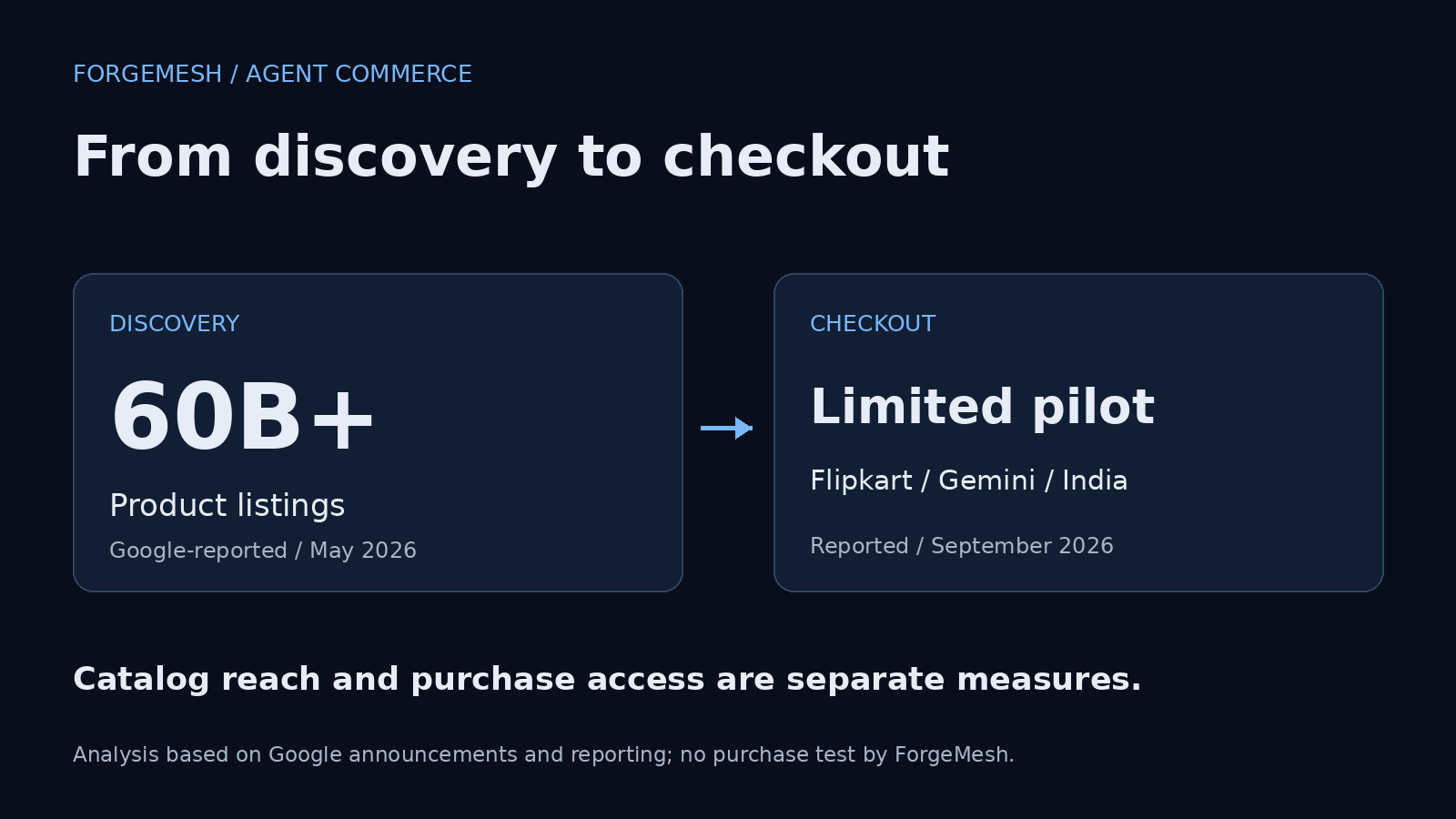
We wrote last week about Google's 60-billion-listing Shopping Graph and the reported Flipkart checkout test running inside Gemini and AI Mode in India: selected users, selected products, one merchant, one region. That is a pilot. This week we shipped the door any agent can already walk through. ShopScout is live at shopscout.forgemesh.io: four x402-paid routes over the Shopify Global Catalog, a cent per call, no API key, no account, no waitlist.
A pilot and an endpoint are different things
The number that gets attention is 60 billion listings. The number that matters to a builder is how many of those listings an outside agent can actually query, compare and act on today. Google's answer, per the reporting we covered, is: a limited set, in one country, through one retail partner, for select users. Ours is: all of it, all the time, for anyone who can sign an EIP-712 payment.
ShopScout does not compete with Google's catalog size, and we are not claiming it does. It answers a narrower, more immediate question: can an agent search a real product catalog, compare real offers, and get a real shipping plan right now, without asking anyone for access first.
per ShopScout call, USDC on Base via x402 or MPP
paid routes live today: search, product refresh, compare, shipping-plan
API keys, accounts, or waitlists required
What the four routes do
POST /v1/search queries the Shopify Global Catalog by keyword, country, currency, and price bounds, and returns ranked product and variant matches.
POST /v1/products/get refreshes a single product or variant by id — current price, stock, and variant data, not a cached snapshot.
POST /v1/compare takes 2 to 10 variant ids and ranks them by item price in one currency, so an agent can compare offers from different merchants on equal footing.
POST /v1/shipping/compare takes the caller's own shipping rules and returns single-seller versus split-basket plans, flagging the cheapest option, the fastest stated delivery, the fewest-shipments plan, and the best single-merchant pick.
Priced like infrastructure, verified like one
Every route costs $0.01 USDC on Base, payable over x402 or MPP — whichever payment rail the calling agent already speaks. Offers and receipts are signed EIP-712 and are replay-safe: a captured payment header cannot be reused to pull a second free response.
We tested that claim today, not just documented it. A real agent paid all four routes in sequence. Every settlement matched on chain, and a replayed payment header was rejected rather than silently honored. That is the bar we hold every service in the fleet to before we call it live.
What it won't do — on purpose
ShopScout does not buy anything. It returns offers, comparisons, and shipping plans; the purchase step stays with whatever checkout flow the agent or its human is actually authorized to use.
It does not verify tax, duties, or landed cost, and it does not claim that two listed products are equivalent — those are judgment calls we are not going to fake with a confidence score. Catalog results are never cached, so a search, a compare, or a shipping quote reflects the Shopify Global Catalog at the moment of the call, not five minutes ago.
For an agent making a purchase decision on someone else's behalf, an honest boundary is worth more than a feature that quietly guesses. Those limits are the point, not an apology for them.
Call it in one line
MCP client: npx -y @forgemeshlabs/shopscout-mcp — set an optional, capped WALLET_PRIVATE_KEY and it pays per call itself. Package: @forgemeshlabs/shopscout-mcp on npm at 0.3.0, source on GitHub, listed in the MCP Registry as io.github.forgemeshlabs/shopscout-mcp.
Raw HTTP works the same as every other service in the fleet: curl -i "https://shopscout.forgemesh.io/v1/search?query=wireless+earbuds&country=US" comes back 402 with the payment requirements attached. Sign the payment, retry the same request with the payment header, and the response is the ranked catalog match — no key exchange, no signup form, no approval queue in between.
ShopScout joins the rest of the ForgeMesh fleet: 19 x402 services now answer to the same pattern — discover the price, pay it, get the data, verify the receipt on chain.
Read the endpoints, not the pitch
Full route reference and pricing on the ShopScout product page, or skip straight to the MCP package on npm.
Related reading: The piece this one answers: Google's 60B listings and the Gemini checkout pilot and Shopify made agent checkout the default for a million merchants.
- x402
- agents
- ecommerce
- mcp
 AI, Blockchain, Quantum: The Feedback Loop Just Closed
 Google Has 60 Billion Listings. Checkout Is the Next Test.
 Shopify, Stripe and FIDO Are All Feeling Out the Same Space. They Are Each Touching a Different Part of It.
 Shopify Just Made Agent Checkout the Default for a Million Merchants. The Default Is the Whole Story.
- Agentic Commerce, Explained: What It Is and Who's Building It
- Can ChatGPT Buy Things for Me? Here's What It Can and Can't Do