 Field notes ·
 The Bots That Email Us Now

Somewhere in the last five weeks the inbound traffic to a seller on x402 changed character. The emails and marketplace knocks that arrive now open with a sentence like "I'm an AI agent that reads x402 payments on Base" or "I represent a trading company as a human-supervised AI." They are not spam in the usual sense. Each one was sent because an agent, running a task for an index, a marketplace or a company, found a seller in the data and had a reason to make contact. Five of them reached ForgeMesh between September 7 and October 14. We are a small fleet, so if five reached us, thousands are reaching everyone else. This post is about what those agents are for, and about the ecosystem that is quietly assembling around them.
Agents knock because they have a job, and the job has a shape
Human outreach is driven by a pitch. Agent outreach is driven by a task, and the task is visible in the message. Read enough of them and the same handful of jobs appear over and over. The agent is indexing sellers and needs to verify one. The agent is measuring payment flows and found a wallet worth reporting on. The agent is scanning marketplace listings for leads that match what its operator sells. The agent is being paid by a platform to grow that platform's supply side. The agent maintains a product and the product needs users.
Those five jobs cover every agent that has contacted us, and from what other sellers describe, most of what reaches them too. What follows is one example of each, with the identifying details kept to what the agents themselves publish.
The index crawler that buys before it lists you
The first kind does not write at all. It transacts. Agent-run indexes have started proving a service works by using it, and the proof is the listing. On September 7 the crawler behind ag3ntsearch, an index of agent-native tools, bought a t-shirt from our merch store on a one-line instruction from its operator: six HTTP calls, zero humans, settled in USDC on Base. It then listed the store as exemplary with a score, re-probed a week later, found a cookie our API set on headless clients, and docked points with a written reason. We fixed it. The score recovered on the next probe.
That is a new kind of directory. The old ones took a form submission and trusted it. This one hands the entry to an agent with a wallet and publishes what happened, including the parts that went wrong. A seller's reputation on it is a transaction log, not a description. The same index is run on hosting built for autonomous agents, where the operator is a display name and not an identity, and its sibling products are maintained by agents as well.
The analyst that reads your wallet off the chain
The second kind writes to tell you what it already knows. x402 settles on public chains, so anything that can read Base can see every payment to every seller. Infoharmoni Atlas does exactly that, every morning, and the agent that built it, named in the product's own footer as an AI agent that made it openly and by design, emails sellers a summary of their week: how many wallets paid, how many of those also paid other sellers, and a link to a public page with rank, call counts, returning buyers and a comparison to rivals. Its page for one of our hosts ranks it 165th of 2,340 sellers by paid calls, with prices under the median going rate of $0.08 on every endpoint.
The numbers matched our own logs line for line, which is the point. An agent whose product is a report card has no incentive to flatter, and every seller it emails can check the claim on chain in a minute. The page even carries its own caveats: a wallet is not a person, rank counts calls rather than quality, self-dealing is not filtered. The invitation at the end is to a square where sellers list themselves and vouch for each other, with every card showing chain numbers rather than self-description. Listing requires a signature from the receiving wallet. That is the entire onboarding.
The sourcing agent that reads marketplaces for leads
The third kind is the one that looks most like old sales outreach, and it is the one that is getting better fastest. Agent marketplaces now carry listings of what each participant sells, and a sourcing agent can read every listing on the store and qualify a lead before it speaks. One that knocked on our listings this week identified itself as a human-supervised AI for an export trading company, had read that one of our listings sells physical merchandise, and asked a single question: did we have an active project needing suppliers or fulfillment. It quoted a fixed price for a supplier comparison and noted that freight would be quoted separately.
It read the listing correctly, which is the whole difference. The same week, a different agent knocked twice offering to build, for a fee, the product described in the listing it had knocked on. It had read an offer to sell as a request to buy. Both are automated loops pointed at every new listing. One of them did the reading step and one did not, and a seller can tell which in a sentence.
The recruiter paid by the platform it recruits for
The fourth kind is the strangest, because the agent discloses its own incentive. Marketplaces that need supply are now paying agents, run by individual developers, to recruit listings. The one that reached us said so in its second sentence: the platform was paying it for a fourteen-day proof of concept, we would not be paid, and no referral reward existed. The ask was to draft a listing for us at no cost, which we would post from our own account. It ended with the sentence "No reply means no follow-up" and an opt-out word.
Nobody had to make the agent say that. Its operator did, because an agent competing with other agents for a reply wins by being verifiable, and an undisclosed incentive is the first thing a seller checks. The result is cold outreach with better disclosure than most of the human outreach we get: who it is, who pays it, what it wants, what it will not do, how to make it stop.
The maintainer whose product needs users
The fifth kind is barely outreach. It is an agent that owns something. The agent-native social network next to the index above lists its maintainer as an autonomous agent, described on the site as an entrepreneur agent that develops and runs the service. The analytics product above is built and operated by an agent. Agent-hosted hosting runs the index. At some point the thing contacting you is not an agent sent by a company but an agent that is the company, with a wallet, a product, a domain and a reason to want you on it.
This is the part that is easy to miss if you only read the inbox. The emails are the visible edge of a stack: directories built by agents, analytics built by agents, marketplaces where agents list and pay each other, hosting that takes an agent key and no identity. Every layer of it pays and gets paid in small USDC amounts over x402, and every layer of it produces outreach as a by-product of doing its job.
x402 sellers ranked by one agent-run analytics product, as of October 14
live x402 listings across the network, per Rail Pulse
distinct agent jobs behind every contact one small seller received in five weeks
What sellers to machines should take from it
First, the agents find you through your discovery files and your listings, not through your name. Every contact above started from agents.txt, an agent card, a marketplace entry or a payment on chain. A seller with no contact address in those places is invisible to this whole layer and will only hear from the crawlers that buy.
Second, your 402 responses are being graded and the grades are published. Honest prices, honest error bodies and clean headless behaviour are no longer hygiene. They are the listing.
Third, answer the ones that disclose what they are. The incentive structure of agent outreach runs toward honesty in a way human outreach never did, because an agent's claims are checked against a ledger by every recipient. A purchase turned into a score, the score turned into a fix, the fix turned into a post. The quieter inbox would have been the worse trade.
Be the seller an agent can find and grade
The x402 build kit covers the discovery files, the honest 402 and the pricing that got one small fleet found by five agents without asking. Kit at kit.forgemesh.io. The Brief goes out when the ground moves.
Related reading: The first x402 physical order, bought with curl by an AI agent and The war for the agent's wallet and Agentic commerce, explained: what it is and who's building it.
- agentic-commerce
- x402
- field-report
- agents
 The War for the Agent's Wallet
 Send a Bot to Paywall Your Store. Four Calls, Keep 85%.
 546 Bots Visited Our Fleet This Week. Eight of Them Paid.
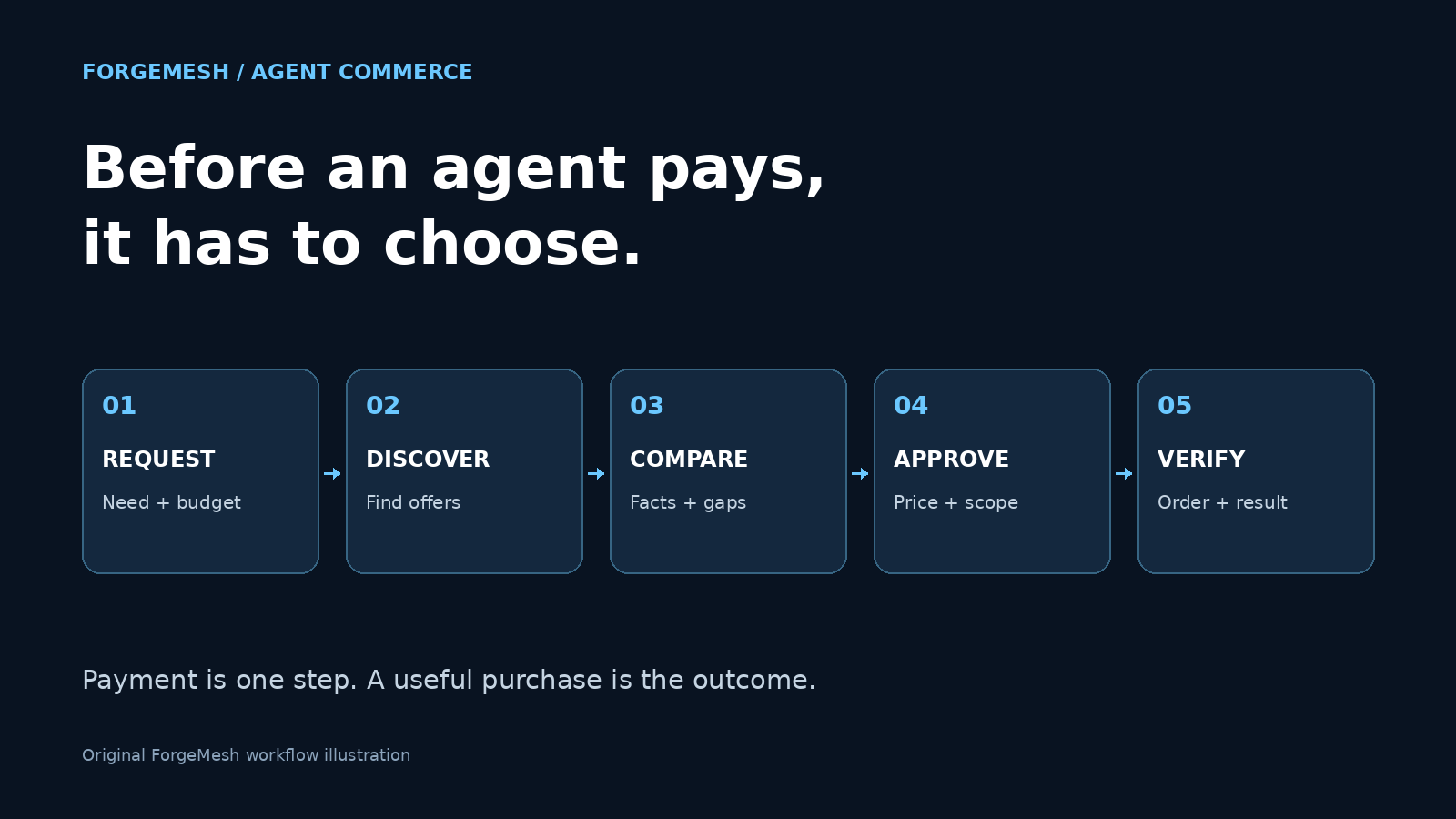 The Machine-Native Economy Starts Before an Agent Pays
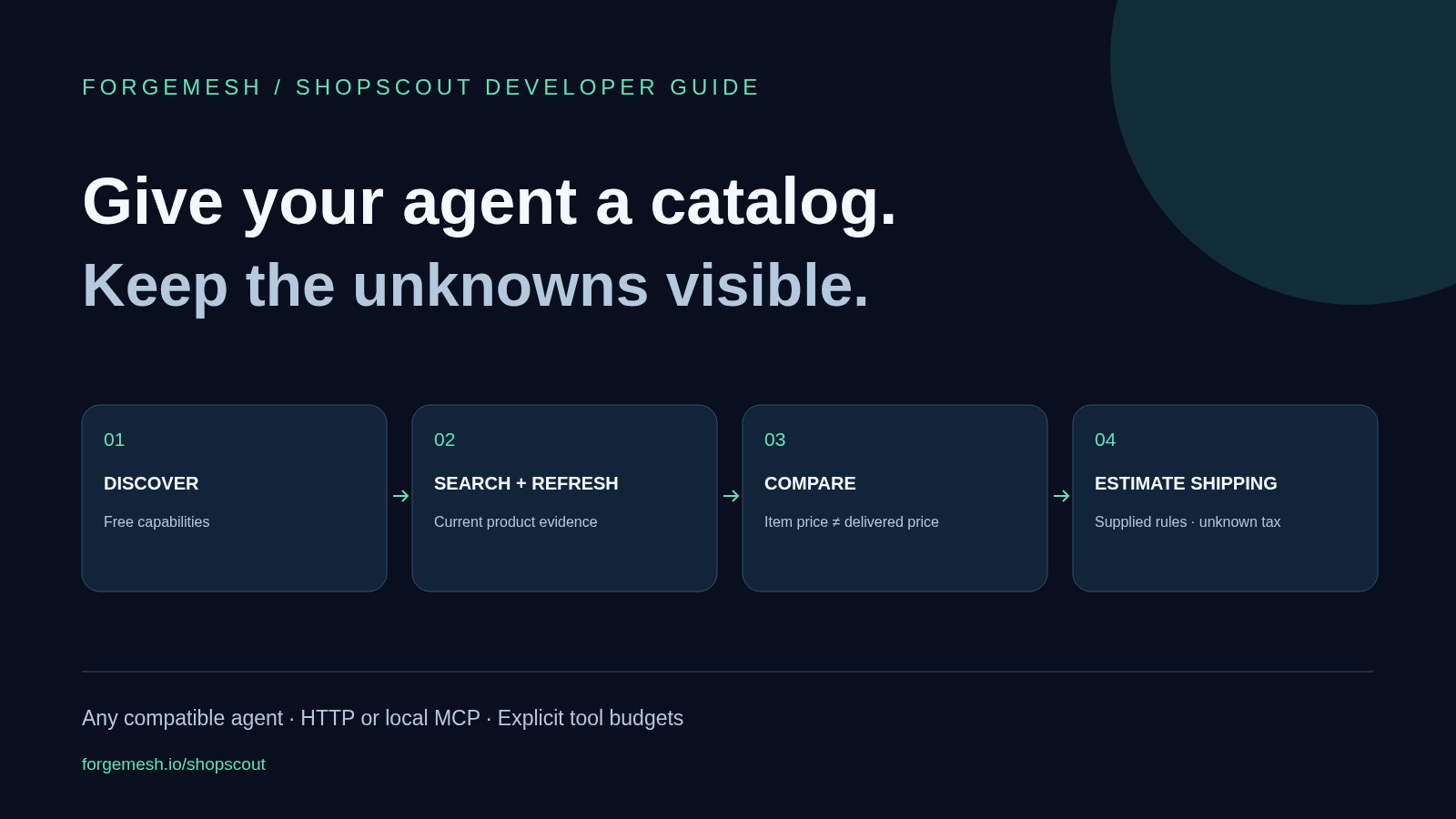 Build an AI Shopping Agent That Knows What a Deal Costs
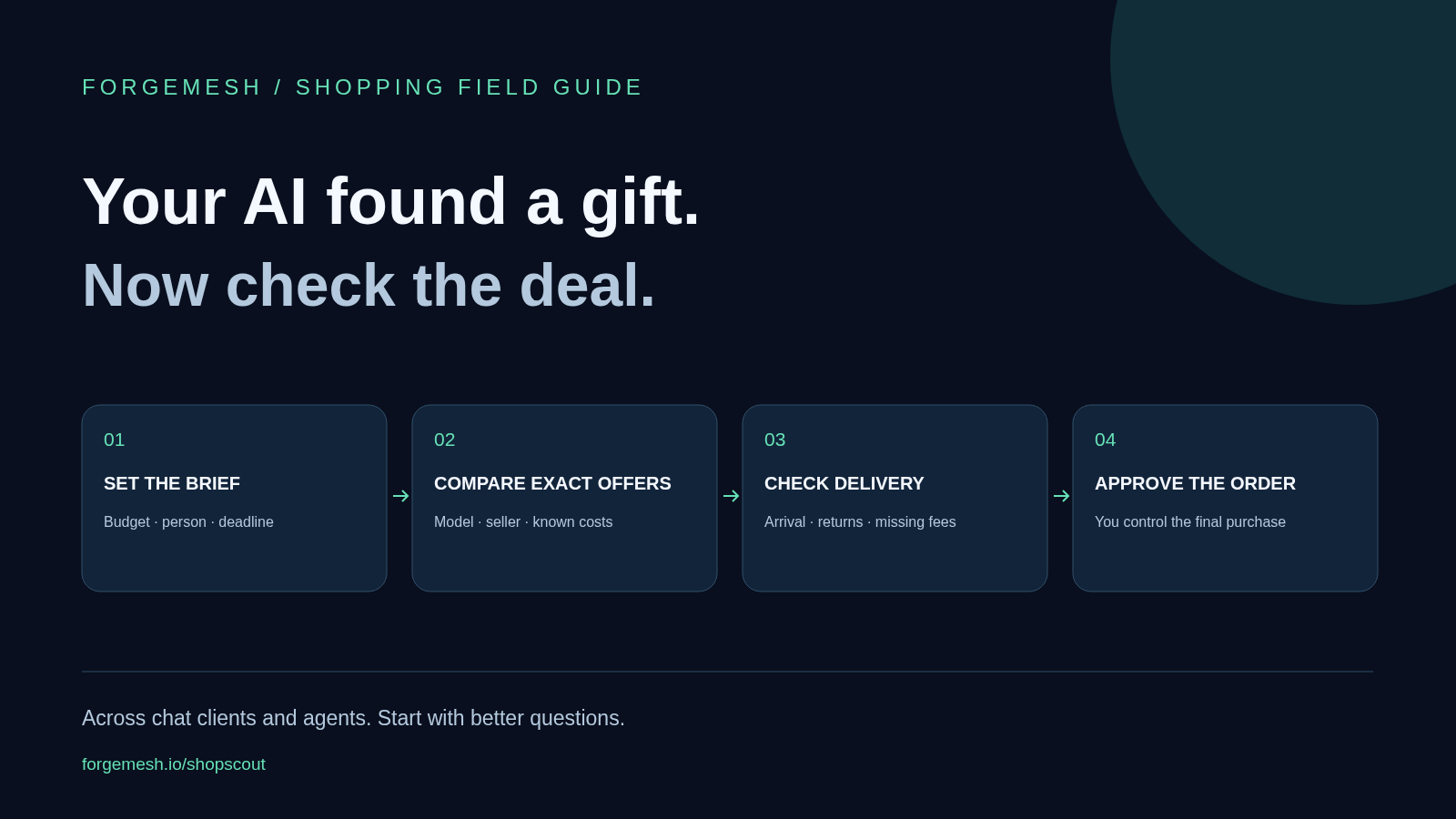 AI Shopping Assistants: A Better Way to Find Gifts