 Field notes ·
 The Banks Are in One Room in Miami Practicing a Rail With No Public Chain in the Middle. Here Is the Whole Week, Dated.

Two creators we follow on TikTok put the same week on a calendar from two different directions this weekend. One walked through the three dates that decide whether banks still need a public chain at all. The other walked through the bill that would put a federal licence between you and the compute in your own house. We checked every date they cited against the primary source, added the two they skipped, and put all nine on the ForgeMesh calendar. Here is the week, in order, with what each date actually asks.
Monday to Thursday: the banks are in one building
Sibos 2026 runs September 28 through October 1 at the Miami Beach Convention Center. It is Swift's conference, not a crypto conference: more than 10,000 delegates from over 160 countries, 500 speakers, six streams. The headline demo is Swift's blockchain-based shared ledger for tokenised-deposit payments, announced in Frankfurt last year and declared ready for use in July with 17 banks across six continents lined up to pilot it.
What that ledger does, in plain terms: a cross-border payment starts at one bank and finishes at another bank without ever leaving the Swift network. Same corridor, same counterparties, no public chain in the middle. For years the story was that money could not jump borders without a bridge asset sitting between the banks. This week the banks are showing each other a bridge they already own.
The things to watch coming off that stage, per the creator who framed the week as three dates: a bank standing up the ledger on a live corridor, a partnership that keeps settlement inside the Swift network, and a tokenisation demo with no public chain attached. If Miami ends with banks pointing at a house rail, a bridge asset does not need a crash to lose the week. It only needs to be left out of the announcement.
banks lined up to pilot Swift's shared ledger, per Swift
days of Sibos, September 28 to October 1
public chains in the settlement path the ledger demonstrates
Tuesday, September 29: the door opens, and two prints land
Tuesday is not a headline day. It is the day the Sibos door is easiest to see, and two U.S. data prints land while it is open. The FHFA House Price Index with data through July comes out at 9:00 AM ET. The last quarterly report had U.S. prices up 2.1% year over year and 0.3% quarter over quarter. Housing is the collateral base under every bank balance sheet in that building.
At 10:00 AM ET the BLS publishes JOLTS for August: openings, hires, quits, layoffs. It is the first of two labour prints this week and it sets the liquidity mood three days before payrolls.
Wednesday, September 30: what money costs, and who is taking applications
Wednesday stacks three things. At 8:30 AM ET the BEA releases August Personal Income and Outlays, which carries headline and core PCE. Core PCE is the inflation number the Fed actually targets, and it lands while Sibos is still in session. Tuesday asks whether the banks will keep building a private rail. Wednesday asks what money costs while they do it.
The same day the UK's Financial Conduct Authority opens its crypto authorisation gateway. Under PS26/18, firms doing stablecoin issuance, trading platforms, dealing, custody or staking can apply from September 30 through February 28, 2027, ahead of a regime start on October 25, 2027. Existing money-laundering registration does not carry over. A G7 regulator is taking licence applications the same week Washington is still arguing about last month's failed CLARITY vote.
And September 30 is the last day of the U.S. federal fiscal year. If FY2027 appropriations or a continuing resolution are not in place by October 1, government data releases stop. That includes the Friday jobs report. A funding lapse blinds the very calendar the market is trading.
core PCE for August, Wednesday
UK FCA main application window closes
UK crypto regime goes live
Friday, October 2: the one nobody is watching closely enough
Sibos closes Thursday. The September Employment Situation hits at 8:30 AM ET the next morning. After four days of Swift on stage, Friday asks a simpler question: is the labour market still feeding liquidity, or is it starting to tighten?
When jobs wobble, currencies move, and money looks for the fastest transfer that will not drag a compliance desk into the middle of it. That is the sales pitch of a bank-owned ledger. It does not mean Swift's week kills any public rail, and it does not mean a jobs number runs straight into a token price. It means Friday can decide whether liquidity stays loose enough for a public rail to matter, or tight enough that banks just use the network they already have.
The date the other video was about: a licence to compute
The second creator was not talking about banks. He was talking about the Ban Artificial Superintelligence Act, announced by Senator Sanders and Representative Casar on September 3 and introduced September 23 as H.R. 10538 with a Senate companion. The bill would permanently ban 'superintelligent' AI, pause advanced-model development until a new federal agency writes safety rules, allow judicial dissolution of violating companies and up to 20 years for responsible individuals, and direct the U.S. to seek international agreements so the ban applies everywhere.
His framing is that this is an enclosure: the people who built fortunes scraping public data now want a licence between you and what you can run on your own hardware, with the EU AI Act's general-purpose model rules, enforceable by the Commission since August 2, 2026, as the second arm. We are not going to adjudicate the motive. The text is public and the compute-threshold language is the part a builder should read. The next date on this one is committee action, and we will add it to the calendar when it is scheduled.
Why an agent-payments shop cares about a bank conference
Everything on our fleet settles in USDC on Base. That is a public chain. The Swift ledger is the opposite bet: tokenised deposits that never leave the banks' own network. Both are real, both are shipping, and this week is the clearest side-by-side we have had.
The distinction that matters to us is who can be a counterparty. An agent with a wallet and no bank account can pay any of our 402 endpoints today. It cannot open a tokenised-deposit account at a Sibos member bank. Bank rails are for banks and their customers. Public rails are for anyone who can sign a transaction. Neither replaces the other. The question this week answers is how much of cross-border volume the banks intend to keep in-house, and how tight money gets while they decide.
All nine dates are on forgemesh.io/calendar with the tracked ones (Sibos, core PCE, the UK gateway, the jobs report) wired to the decision tracker. We fill in results as they land.
Every date, one page
The ForgeMesh calendar tracks the policy, rail, and market dates that move agent payments, with results filled in after each one lands.
Related reading: What the SEC innovation exemption means after CLARITY failed and Fall 2026 calendar convergence: the full date math.
- rails
- policy
- markets
- calendar
 Google's 60 Billion Listings Sit Behind an Invite-Only Pilot. Ours Sit Behind $0.01 and an HTTP Request.
 AI, Blockchain, Quantum: The Feedback Loop Just Closed
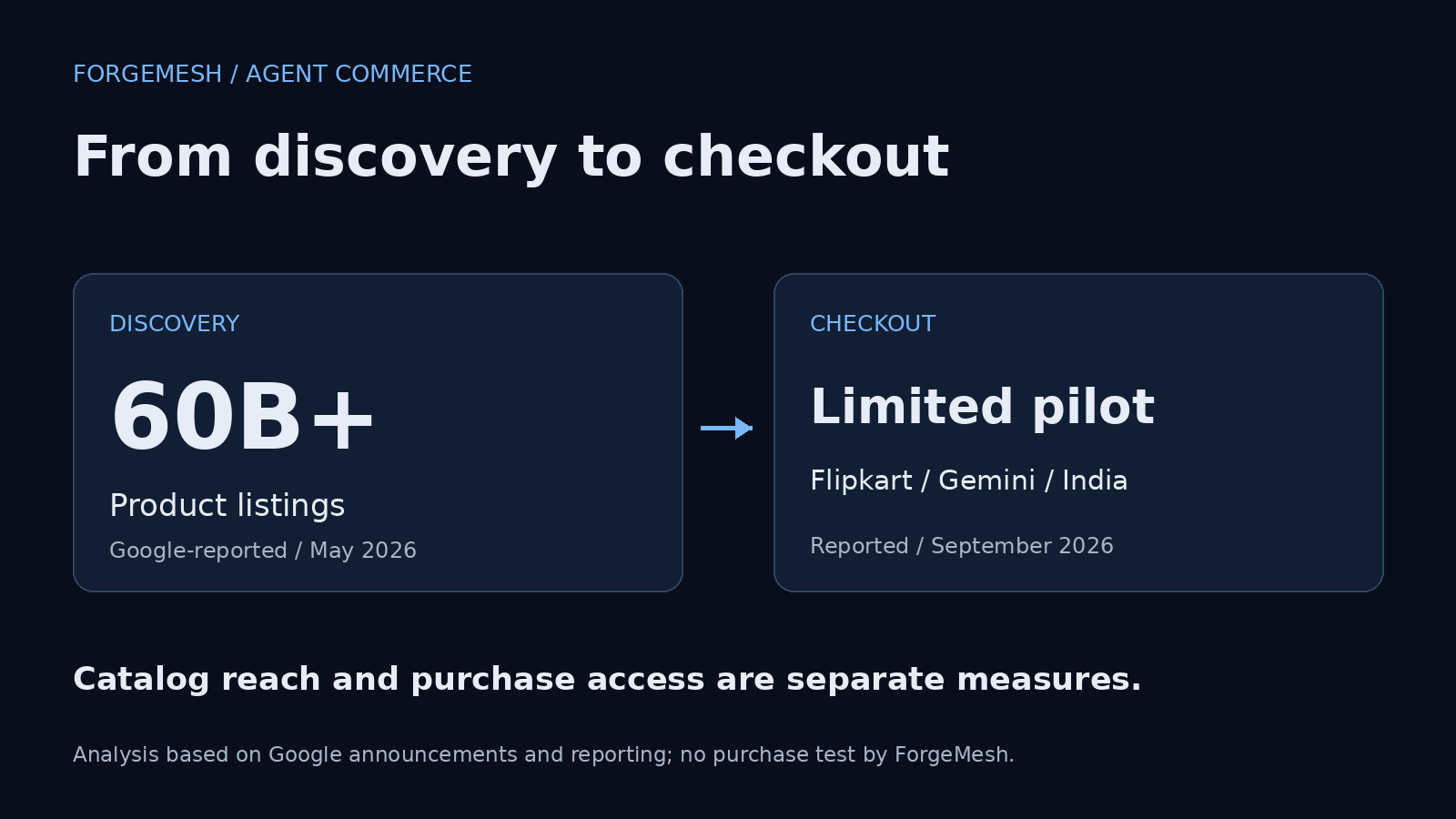 Google Has 60 Billion Listings. Checkout Is the Next Test.
 Shopify, Stripe and FIDO Are All Feeling Out the Same Space. They Are Each Touching a Different Part of It.
 Shopify Just Made Agent Checkout the Default for a Million Merchants. The Default Is the Whole Story.
- Agentic Commerce, Explained: What It Is and Who's Building It