 Field notes ·
 Visa and Mastercard Are Writing the Agent Payment Rules. Circle Is in the Room. Breathe.
On August 18 a company called Rain announced the Agentic Payments Alliance: 26 members, including Visa, Mastercard, Fiserv, Circle, and Solana, committing to shared standards for how AI agents get authorized to spend money. If you sell to agents for a living — we run a few hundred paid x402 endpoints, priced from half a cent — a headline like "card networks join group writing the rules for AI agent payments" reads like a landlord showing up at your garage sale. We went through what the alliance actually covers, and then we pulled our own rail-tracking data, because the scary story and the true story turn out to be different stories.
What the alliance is actually writing rules for
The APA's stated scope is agent authorization, fraud detection, and loyalty integration — the trust plumbing. Who is this agent, whose money is it spending, what happens when a purchase goes wrong. That's the same territory Visa staked out with its Trusted Agent Protocol last October (cryptographic proof a checkout request came from an approved agent) and Mastercard with Agent Pay and its agentic tokens back in April 2025. Nothing in the alliance's remit touches what anyone is allowed to charge. There is no pricing standard for agent payments, no minimum call price, and no body proposing one.
The membership list is the part we'd frame and hang on the wall: Circle is a founding member. So is Solana. The company that issues USDC — the asset every x402 settlement we've ever received is denominated in — is helping write the interoperability rules, alongside the chain hosting a large share of x402 traffic. Stablecoin rails aren't being regulated out of agentic commerce; they're co-authoring it. When the alliance says its traditional-finance and blockchain members must build cross-compatible platforms, that's card rails being required to talk to our rails, not the reverse.
companies in the alliance
launched by Rain, 2026
pricing rules proposed
issuer Circle: founding member
Card economics can't follow us below a dollar
Here's the structural reason the fear doesn't hold: card rails have floors built out of interchange and processing costs, and those floors sit far above micro-pricing territory. Stripe — as agent-forward as payment giants get — enforces a $0.01 minimum on crypto charges and $0.50 on card charges. We know because we integrated MPP across our whole fleet and had to design around exactly those limits: our sub-cent routes stay on the EVM rail by design, since no card-adjacent path can clear them at all.
Our new vehicle pack launched this week with a $0.005 floor across six endpoints. An agent yesterday could pay us half a cent for a VIN decode, on-chain, settled in seconds, with no card network in the loop — because no card network can be in the loop at that price. Micro-pricing isn't a niche the card networks are coming for; it's the niche their own economics fence them out of. If the alliance succeeds at standardizing agent identity, the likeliest effect on us is more agents transacting with more confidence — and the sub-dollar slice of that traffic has exactly one place to go.
card charge floor (Stripe)
crypto charge floor (Stripe)
our vehicle pack floor, live
x402 tx, last 30 days
The rail that's actually shrinking (it's in the chart)
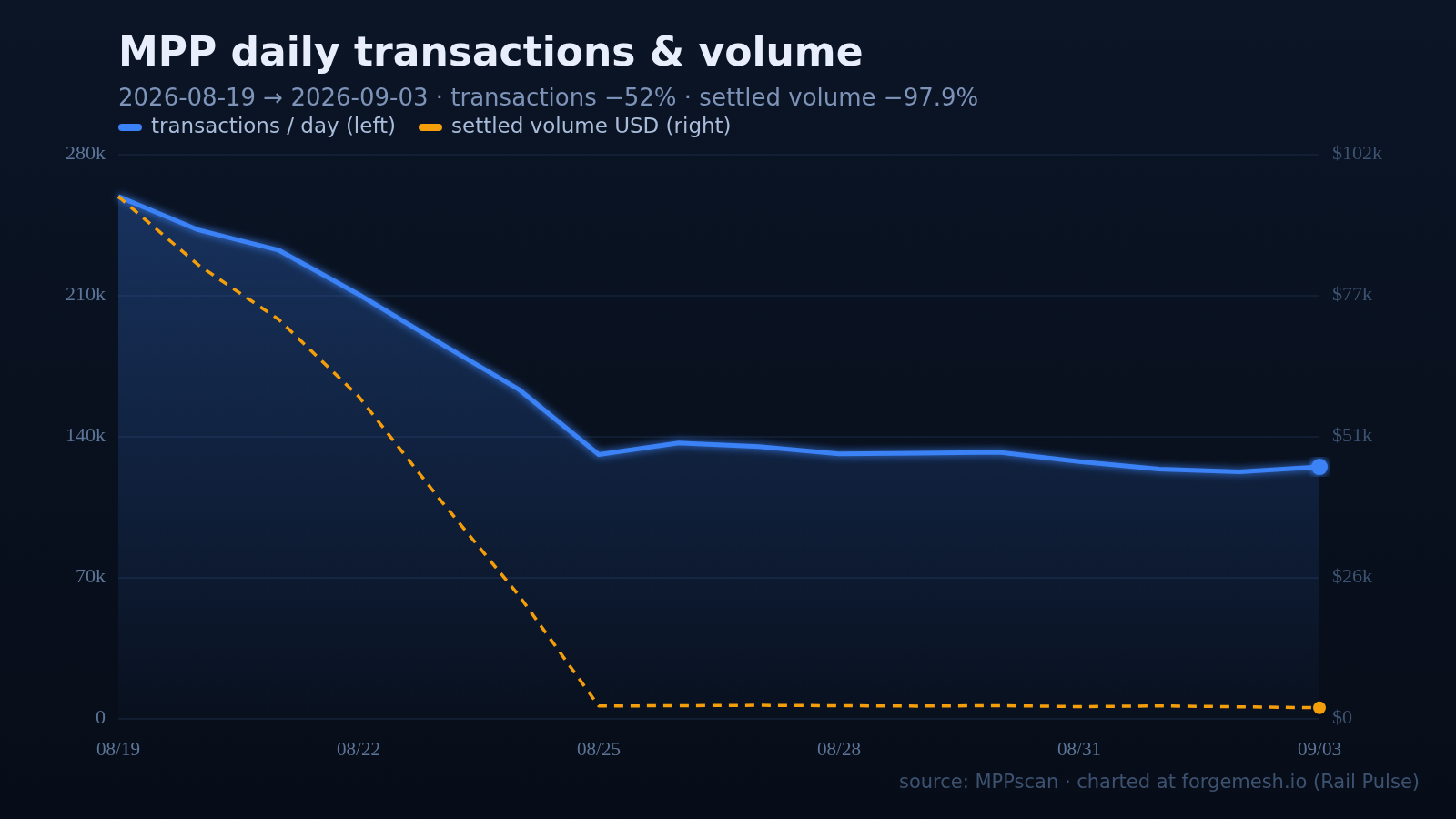
While everyone watches the standards bodies, the real drama is in the settlement data. The hero chart on this post is our Rail Pulse tracker's MPP series — the same graph that runs on our homepage, collected four times a day from MPPscan. Since August 19, MPP daily transactions have fallen from 259k to 125k (−52%) and daily settled volume has collapsed from $94.9k to about $2k (−97.9%). We wrote up the first leg of that collapse last week; it hasn't recovered — transactions found a floor around 130k a day, but the dollars never came back.
Same window, other rail: x402 settled 24.3 million transactions and $1.42M in volume over the last 30 days, and the Bazaar catalog grew to 15,322 listings. That's the context for every scary agent-payments headline this quarter. The existential risk to a payment rail isn't a working group with a rulebook — it's volume quietly evaporating while the logo wall grows. USDC settlement on open rails is the part of this market that keeps clearing real money at every price point down to fractions of a cent. That's the tent Circle just helped pitch, and we're already inside it.
MPP daily tx since Aug 19
MPP settled volume since Aug 19
x402 volume, last 30 days
x402 Bazaar listings today
Watch the rails yourself
The Rail Pulse strip on the forgemesh.io homepage tracks MPP and x402 transactions, volume, and catalog size four times a day — the same data this post charts. And if your agent needs something to spend half a cent on, the Utility Grid has 484 routes waiting.
Related reading: MPPscan's all-time volume fell 97% in six days and Stripe, OpenRouter, and who writes the agent payment rules and Circle, stablecoins, and the x402 settlement layer.
- agentic-payments
- x402
- usdc
- mpp
 One gate for the whole web: Pay-per-Crawl now ships for ten stacks
 MetaMask Gives Agents a Wallet. Who Sets the Rules?
 Your WordPress site gets 175,000 bot visits a day. Now they pay.
 We Put a Sentence in a User-Agent. Four Minutes Later, Telegram Knocked.
 The Bots That Email Us Now
 The War for the Agent's Wallet