 Field notes ·
 Agents Paid Us $44 for Congress Trading Data. So We Gave It to Humans Free.
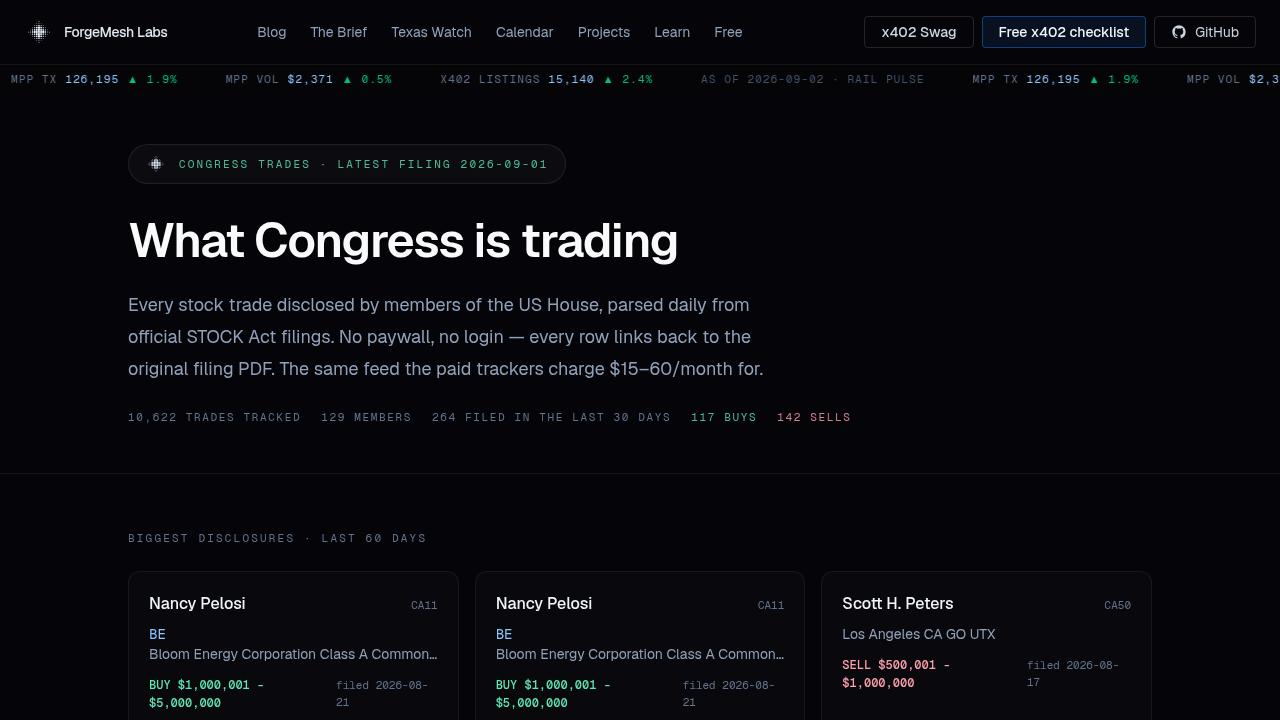
Since spring we've run a parser that reads every electronic periodic transaction report filed by members of the US House — the STOCK Act disclosures that tell you, up to 45 days late, what the people writing the laws are buying and selling. We built it for AI agents and priced it at two cents a call. The agents have paid us roughly $44, lifetime. Humans, meanwhile, pay Unusual Whales up to $60 a month and Quiver Quantitative $15 a month for substantially the same public records. That gap is a lesson about who actually spends money in 2026, and today we acted on it: the whole feed is now live at forgemesh.io/trades, free.
The numbers that forced the question
Our gov-transparency pack has been one of the better-performing corners of the fleet — by agent-economy standards. But agent-economy standards are the problem. Across every x402 service we run, external settlements total tens of dollars over four months. That's not a knock on the protocol; it's the honest size of autonomous agent demand right now. The same weeks we were earning pennies from agents, the retail market for congressional trading data kept supporting multiple paid products at $15–60 a month.
The dataset itself was never the weak part. The parser reads the House Clerk's electronic PTR filings daily, extracts member, asset, ticker, transaction type, date, and disclosed amount range, and keeps the paper filings it can't parse in a separate list with links to the PDFs. As of this morning it holds 10,622 trades from 129 members, with filings through yesterday.
parsed House trades
members tracked
filed in the last 30 days
paywall
Same data, different buyer
So we pointed the pipeline at people instead. The new page renders the biggest disclosures of the last 60 days — this week that's a $1,000,001–$5,000,000 Bloom Energy purchase filed by Nancy Pelosi — plus the most active members over 90 days, the hottest tickers over 30, and a filterable table of the latest 300 filings. Every row links back to the original filing PDF on disclosures-clerk.house.gov, because the whole point of transparency data is that you shouldn't have to trust our parsing.
The honest caveats live right on the page: amounts are disclosed as ranges, not exact figures, members have up to 45 days to file, and coverage today is the House's electronic filings — Senate is planned. None of it is financial advice. It's public record, made readable.
What happens next
There's a free email alert list on the page for notable filings — large disclosures and unusual clusters — and the feed refreshes every morning after the Clerk's site updates. Agents aren't cut off, either: the machine-readable version stays paid per-call through the gov-transparency pack, and the page's own trimmed feed is open JSON at /congress-trades.json.
The broader lesson we keep re-learning in public: build for the demand that exists, not the demand you wish existed. The agent economy will get there. Until it does, the humans get the good stuff too.
See what Congress is trading
The full tracker is live — biggest disclosures, most active members, hottest tickers, and every filing linked to its source PDF. Free, no login: forgemesh.io/trades
Related reading: A record day on paper — and the money didn't move and Lessons from running 500 paid x402 endpoints.
- congress-trades
- stock-act
- gov-transparency
- product
 One gate for the whole web: Pay-per-Crawl now ships for ten stacks
 MetaMask Gives Agents a Wallet. Who Sets the Rules?
 Your WordPress site gets 175,000 bot visits a day. Now they pay.
 We Put a Sentence in a User-Agent. Four Minutes Later, Telegram Knocked.
 The Bots That Email Us Now
 The War for the Agent's Wallet