 Field notes ·
 AI, Blockchain, Quantum: The Feedback Loop Just Closed
The convenient way to tell the story of modern computing is as three separate waves: AI arrived, blockchain arrived, quantum is arriving. That framing quietly broke this year. AI agents now do real work and pay for it over crypto rails. Quantum progress now threatens the signature schemes those rails settle on. And AI itself is now being pointed at quantum's hardest engineering problems, compressing the very timeline the crypto layer is racing against. Three waves, one system — and the clock inside it sped up in 2026.
Wave one and two already merged
The first two waves stopped being separate some time ago. AI agents that browse, decide and transact need a payment medium that works at machine speed, settles in seconds and does not require a human tapping a card form. In practice that has meant stablecoins on fast chains, with protocols like x402 turning an HTTP 402 response into a machine-payable invoice.
We are not observing this from the sidelines. Our own fleet of paid endpoints has settled 880+ on-chain payments from 200+ distinct agent wallets on Base, paid in USDC, most of them with no human anywhere in the loop. Every one of those settlements rests on an ECDSA signature over the secp256k1 curve — the same elliptic-curve cryptography that secures Bitcoin, Ethereum and effectively the entire agent-payment stack.
That last detail is the hinge of this article. The agent economy did not just adopt blockchains; it adopted their threat model. Whatever threatens elliptic-curve signatures threatens the rails agents pay on.
2026: logical qubits stopped being slideware
For years the honest answer to "when will quantum matter?" was "when error correction works." Physical qubits are noisy; the whole game is combining many of them into logical qubits whose error rate falls as you add hardware. In 2026 that crossover was demonstrated on real machines, repeatedly, by different groups on different hardware.
Google's Willow line showed logical error rates dropping by a factor of roughly two with each increase in surface-code lattice size — the scaling behavior theorists predicted, measured on hardware. QuEra published 96 verified logical qubits built from 448 neutral atoms in Nature in January. Quantinuum demonstrated logical qubits outperforming the physical qubits they are made of. And China's Zuchongzhi 3.2 achieved below-threshold error correction — the first such demonstration outside the United States, which tells you this is now an engineering race, not a single lab's result.
None of these machines can break a 256-bit elliptic-curve key today. Cracking one is generally estimated to need thousands of logical qubits, and the field just crossed into the double digits and low hundreds. But the argument that fault tolerance might simply never work — the load-bearing assumption behind "quantum is always ten years away" — did not survive 2026.
verified logical qubits demonstrated by QuEra (Nature, Jan 2026)
logical error reduction per lattice-size step on Google's Willow line
NIST deprecation target for RSA-2048 and ECC P-256
The loop closed: AI is now building quantum
Here is the part that changes the timeline math. The two hardest day-to-day problems in scaling quantum hardware — calibrating thousands of analog control parameters, and decoding error-correction syndromes in real time — are pattern-recognition problems. They are, in other words, exactly what machine learning is good at.
NVIDIA made that explicit this year with Ising, an open family of AI models for QPU calibration and error-correction decoding, and with its Accelerated Quantum Research Center, where IonQ is installing a Superion 256 system wired directly to a GB200 NVL72 AI supercomputer over NVQLink. The design intent is not subtle: GPUs sit in the quantum control loop, and AI models learn the machine's noise faster than human calibration teams can.
This is why we think "quantum is coming fast" is now the sober read rather than the hype read. Every prior estimate of the quantum timeline assumed quantum engineers working at human speed. The field's bottleneck problems are now being attacked by the most heavily capitalized technology on earth. When the tool that is improving fastest gets pointed at the clock, the clock moves.
Quantum's first real target is the signature — and the signature is money
A cryptographically relevant quantum computer running Shor's algorithm does not "hack blockchains" in some diffuse way. It does one specific thing: derives a private key from an exposed public key. That maps to two concrete attacks — cracking funds at rest in addresses whose public keys are visible on-chain, and racing a transaction in the mempool during its confirmation window.
The at-rest exposure is not hypothetical. Roughly 6.7 million BTC — about a third of circulating supply — sits in addresses with exposed public keys, including early pay-to-pubkey coins and every reused address. Those coins are effectively a bounty that vests the day a large enough machine exists. And the harvest now, decrypt later pattern means adversaries do not need to wait: anything recorded today, from encrypted traffic to on-chain public keys, can be stockpiled and attacked retroactively.
Institutions are treating the timeline as real. NIST's transition guidance deprecates RSA-2048 and ECC P-256 by 2030 and disallows them by 2035, with ML-KEM, ML-DSA and SLH-DSA standardized as the replacements. On September 23 of this year, the EU's three financial regulators added quantum computing to their official systemic risk map. Risk committees do not put things on that map for fun.
The chains are moving — slowly, in public
The blockchain layer is responding, and the responses are worth reading because they reveal how hard the migration actually is. Bitcoin has BIP-360, which proposes Taproot-style addresses with the quantum-vulnerable key path removed, and BIP-361, a phased sunset of legacy signature types. Ethereum is leaning on account abstraction so individual accounts can adopt post-quantum signatures without a single protocol-wide flag day, with core post-quantum infrastructure targeted around 2029.
Notice what a chain migration requires that a normal IT migration does not: millions of independent key-holders each taking action, including holders who are inattentive, dead or gone. A bank rotates its certificates centrally. A blockchain has to persuade every wallet to move itself. That coordination cost is exactly why the work is starting years before the threat is operational — and why 2029-ish roadmaps against a 2030 deprecation deadline leave less slack than they appear to.
The uncomfortable symmetry: the same properties that make crypto rails ideal for autonomous agents — bearer assets, unstoppable settlement, no central administrator — are the properties that make the quantum migration hard. There is no support desk that can reset your key when the curve breaks.
What we're doing about it, and what we'd tell builders
Our position is not panic; it is posture. Nothing in the 2026 results suggests elliptic-curve keys fall this decade with certainty. Everything in them suggests the window is finite and now compressing under AI acceleration, which means crypto agility — the ability to swap signature schemes without rebuilding your product — has become a design requirement rather than a nice-to-have.
Concretely, for anyone running money over agent rails, the checklist we hold ourselves to: never reuse addresses (an unexposed public key is still quantum-safe at rest); keep hot-wallet balances small and sweep to fresh keys; inventory every place your stack depends on secp256k1 so a future migration is a config change, not an archaeology project; and watch BIP-360 and Ethereum's account-abstraction path the way you watch a dependency's major-version roadmap — because that is what they are.
The progression is real: AI gave machines judgment, blockchains gave them money, and quantum will re-cut the keys to both. The builders who come out of that transition intact will not be the ones who predicted the exact date. They will be the ones who made the date not matter.
The rails are the story
The ForgeMesh Brief tracks the agent economy where it actually settles — payments, protocols and the infrastructure shifts underneath them. Get the next Brief.
Related reading: How the major platforms approach agent commerce and Our comparison of AI agent wallet stacks.
- ai
- quantum
- crypto
- analysis
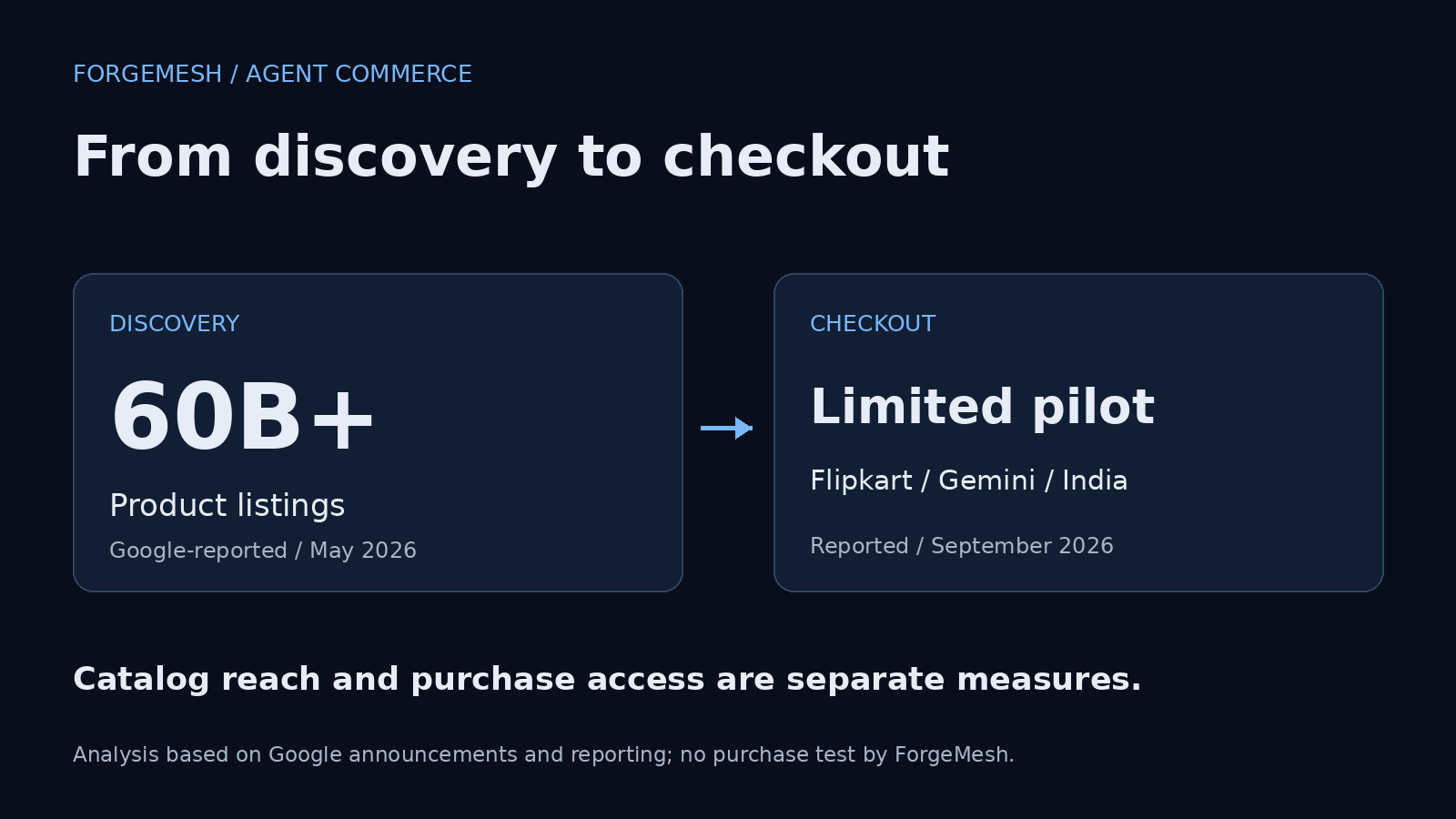 Google Has 60 Billion Listings. Checkout Is the Next Test.
 Shopify, Stripe and FIDO Are All Feeling Out the Same Space. They Are Each Touching a Different Part of It.
 Shopify Just Made Agent Checkout the Default for a Million Merchants. The Default Is the Whole Story.
- Agentic Commerce, Explained: What It Is and Who's Building It
- Can ChatGPT Buy Things for Me? Here's What It Can and Can't Do
- AI Agent Wallets Compared: Coinbase, Stripe, MetaMask, Cloudflare