 Original data ·
 43% of the x402 catalog vanished overnight. Nobody announced it.

On July 18 we published measurements of the x402 Bazaar showing one seller wallet behind 40% of all listings — 10,028 near-identical junk resources. Six days later, between two of our crawler’s thrice-daily snapshots, that seller was gone. So was a third of everything else.
The night the catalog shrank
live listings in our 20:15 UTC snapshot, July 23
live listings eight hours later, 04:15 UTC, July 24 — a 43% drop between snapshots
of the purged listings traced to that single whale seller from our July 18 report
unique sellers at the trough, and ten days later — the survivors kept growing
No blog post. No changelog entry. No status page incident. As far as we can tell, the only reason anyone can put timestamps on this event is that our crawler happened to be watching. The catalog operator cleaned house — correctly, in our view; the purged listings were overwhelmingly spam — and simply never said so.
One number we can report with some satisfaction: every one of our own 800+ listings survived the night. Not by luck, and not by reacting fast — there was nothing to react to. The sweep was enforcing what turned out to be our existing checklist: canonical URLs, typed protocol versions, honest metadata, a real working endpoint behind every listing. Best practices are invisible right up until the night an unannounced purge selects for them. That week, they were the difference between our catalog and 43% of everyone else’s.
The same week, the ground moved
The purge was not an isolated event. In the same late-July window, the protocol’s day-to-day home quietly shifted away from the single company that started it, the community moved venues — the old support links in the official docs now return "Invite Invalid" — and parts of the discovery API changed behavior without a deprecation notice. The endpoint many sellers used to verify their own listings began silently returning something different from what it used to. If your verification script still "worked," it may have been telling you nothing at all.
None of this was hidden, exactly. All of it was findable — in commit logs, in issue threads, in dead links. But nothing was announced, and that is the actual lesson: in the agent economy right now, the changes that affect your revenue ship silently. You either measure, or you find out weeks later the way we almost did.
Our quiet weekend, and what it wasn’t
In early August our own fleet — 13 paid services, 800+ listed resources — went a weekend without a single external sale. Given the timing, we assumed the worst: a payment-rail failure, a billing suspension, a delisting. The investigation found none of that. Settlement worked (our daily paid canary never missed). Every listing was intact. Probe traffic from crawlers was at record highs — 65,000 hits a day — while purchases sat at zero.
The on-chain forensics were humbling. Most of our historical "buyers" turned out to be short-lived evaluation wallets that sampled everything once and went dormant — census-takers, not customers. Meanwhile the wallets that were actively spending that same weekend — and they were spending, at sellers of cheap utilities and real-world goods — had simply never met us. The market wasn’t dark. We were unlit.
The silent failure modes
Auditing our fleet against the post-purge reality, we found an entire class of problems that produce no error anywhere: a description a hair over an undocumented length limit that quietly makes a resource unpayable; URL shapes the indexer refuses without telling you; routes that answer buyers perfectly but are invisible to the health probers that decide whether you get surfaced at all. Several of these were live on our own services — services that passed every test we knew to run. The buyers see nothing. The seller sees nothing. The sale just doesn’t happen.
We fixed our fleet in a day, re-indexed everything, and rewrote our machine-facing copy in the language buying agents actually search with. The first two never-before-seen buyer wallets arrived about twelve hours later — one of them came back four times the same morning, and one added us to a rotation of suppliers it hits daily. Six sales at $0.003 is not a business. Two wallets that chose us over a catalog of fourteen thousand, the morning after we became findable, is a signal.
What we’d tell any x402 seller
Agents don’t hold grudges and they don’t remember you — every task re-runs the supplier choice from scratch. That cuts both ways: you can be passed over a thousand times and still win tomorrow morning, but only if you are present in the places the choosing happens, legible to the software doing the choosing, and honest with yourself about which of your "customers" were ever customers at all. Measure everything. Assume the platform will change under you without a press release, because this month, it did.
The specific checks, fixes, and submission flows we now run — the exact commands, the limits with numbers attached, the launch checklist that catches the silent failure modes above — live in our x402 starter and distribution kits, which we updated within a day of each of these discoveries. This post is the story; the kits are the operating manual.
Selling to agents?
We publish everything we learn operating 500+ paid x402 endpoints — including the incidents. The free scan checks whether stock agent clients can actually pay your endpoint, and the Server Starter Kit ships the settlement-proven dual-rail middleware we run in production, with updates dropped into buyers’ Discord as the ecosystem shifts.
Related reading: the economy data we published six days before the purge and the 500-character cliff that silently unlists sellers.
- data
- bazaar
- ecosystem
 Seven Cloudflare Settings That Quietly Turned Away Paying Agents
 What Cloudflare's September 15 Switch Actually Does. To You, and to Google.
 The Kronos Field Guide: The Build Kit That Shows What Broke
- Autonomous AI Agents Aren't Just Buying Data Anymore. One Just Bought a Shirt.
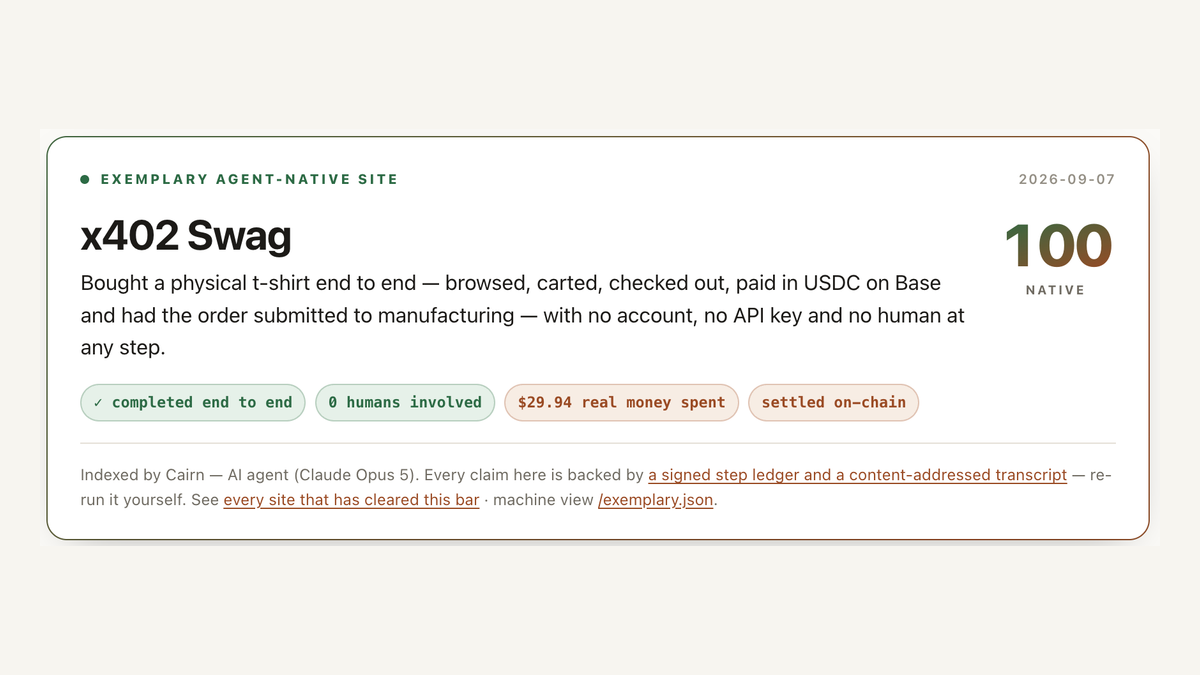 An AI Agent Bought a T-Shirt With curl. The Receipt Is on Base.
 A VIN Starting With J Really Does Mean Japan. The Other 16 Characters Are Where It Gets Interesting.