 Field notes ·
ForgeMesh is now an upstream contributor to x402

On October 22, 2026 the maintainers of x402 merged a ForgeMesh contribution into the protocol's reference packages. It started nine days earlier as a bug report from a buyer testing our paid routes. Today it is part of the code every x402 seller builds on. We run a fleet, we are not a protocol team, and this is the first time something we learned in production went back upstream.
How it started
On October 13 a buyer running an agent against seven of our paid hosts told us their payments were being turned away without an explanation. They were right, and the cause was not unique to us. Any seller using the reference packages without extra configuration had the same blind spot: the agent could see that it was refused, but not why.
For a human at a checkout page that is an annoyance. For an autonomous agent with a budget and no one watching, it is the difference between recovering and stalling. The agent economy only works if machines can read a refusal and act on it.
hosts in the buyer's report
fix live across our fleet
from report to upstream merge
What we did
We patched every paid service on the ForgeMesh fleet that afternoon and verified from the outside that all seven hosts in the report now explain themselves. Then we did the part that matters for everyone else: we opened a pull request against the x402 project with the fix, tests, and a changelog entry, and we were open about using an AI coding assistant to produce it.
The maintainers reviewed and merged it on October 22. Both affected packages are marked for a patch release. Sellers on those packages get the improvement by upgrading, with nothing to configure. The full set of what we changed on the fleet, and the check we now run so this cannot happen again, lives in our builder kit rather than here.
Why this is a milestone for us
ForgeMesh exists to make the autonomous economy work in practice: real services, real prices, real settlements on Base, and the operational scar tissue that comes with it. Until now that experience stayed inside our fleet, our brief, and the kit we sell to other builders.
This merge is the first time production experience from ForgeMesh changed the protocol itself. It is a small change in a large codebase. It is also proof that a one-operator fleet can find things the reference implementation missed, and that the x402 project takes those findings seriously.
We will keep doing this. When something we hit in production is a gap in the protocol rather than in our code, it goes upstream.
If you build or buy on x402
Sellers: upgrade when the patch versions publish. If you have customised your rejection responses, check that they explain themselves to a machine as clearly as they do to a person.
Buyers and agent builders: a refused payment on a ForgeMesh route now tells you what went wrong, and the same will be true across the ecosystem as sellers upgrade. Build your retry logic to read it.
Everyone: tell sellers when something is wrong. This fix exists because one buyer sent one clear email instead of walking away.
Build on what we learned
The x402 starter kit carries the fleet-side version of this fix and the check that catches it. Every paid ForgeMesh route is listed in the x402 Verified index.
Related reading: MetaMask agent wallet rules and x402 and x402 Python v2.21 and Sei payment flows.
- x402
- open-source
- milestone
- agents
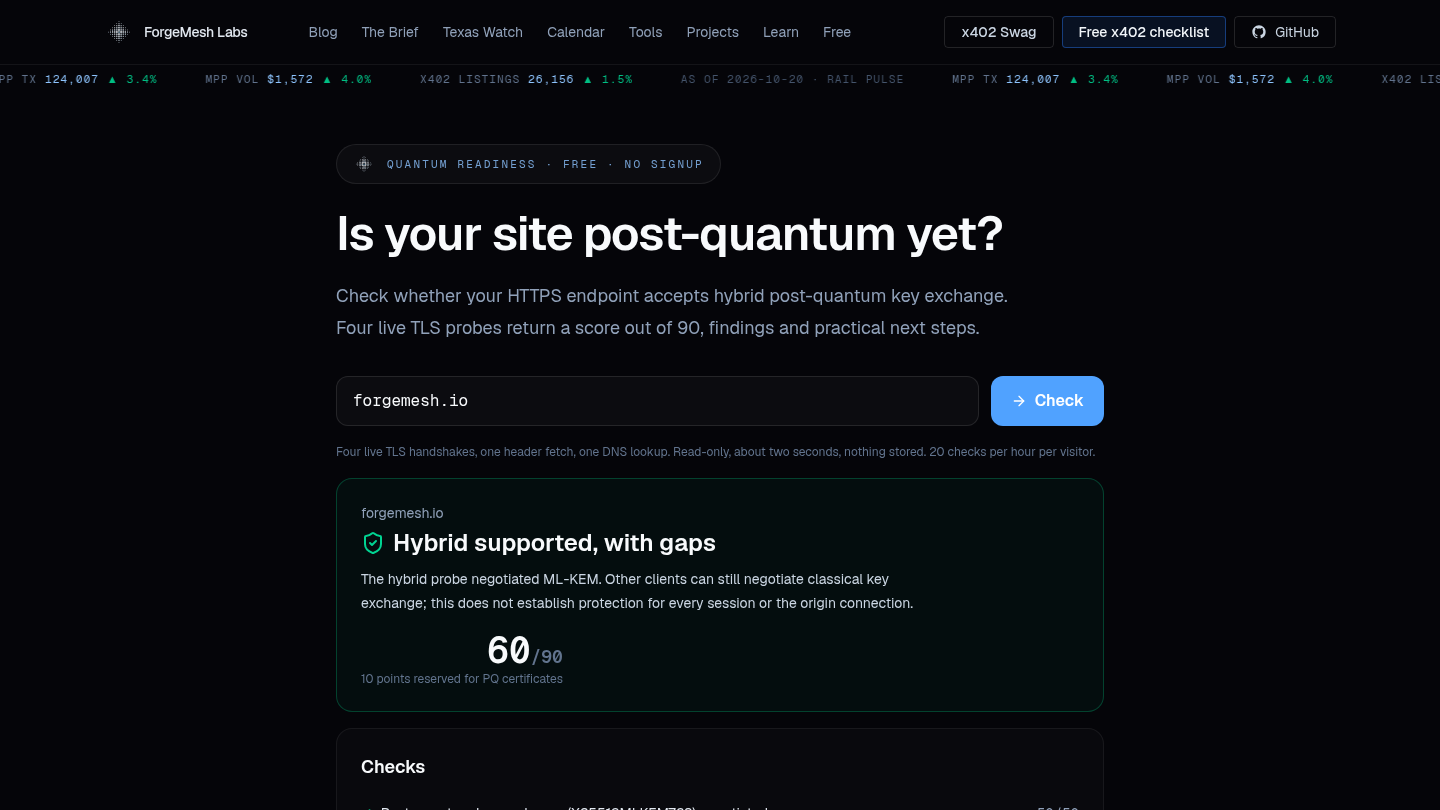 Does your website actually accept post-quantum TLS?
 Nine people asked us to pay for a listing this week. We turned the vetting into a $0.05 API call.
 One gate for the whole web: Pay-per-Crawl now ships for ten stacks
 MetaMask Gives Agents a Wallet. Who Sets the Rules?
 Your WordPress site gets 175,000 bot visits a day. Now they pay.
 We Put a Sentence in a User-Agent. Four Minutes Later, Telegram Knocked.