 Field notes ·
 The Bill Died Tuesday. The Rulebook Showed Up Thursday Anyway.

On Tuesday, September 15, the Senate's cloture vote on the CLARITY Act failed 49–50 — not just short of 60, short of a simple majority. Bitcoin slipped through $75,000 within the hour, Coinbase fell about 8%, and Circle about 11%. We had the vote circled on the calendar since August as the day the rulebook for agent money got decided. Then on Thursday the SEC issued a five-year Innovation Exemption that lets venues trade tokenized stocks on-chain, the CFTC sent its own crypto market rules to the White House on the 18th, and Bitcoin closed the week above $81,000. The bill lost; the rulebook shipped anyway. Here is what actually happened, in order, and why the tape read a legislative defeat as a win.
Tuesday: 49–50, and it wasn't the market structure that failed
The vote (roll call 234) went down at 3:00 PM ET. Eleven votes short of cloture, one short of a majority. The part worth understanding is who voted no. Seven Democrats who spent months negotiating the text — Gillibrand, Warner, Booker, Warnock, Gallego, Alsobrooks, and Cortez Masto — all voted against advancing it, and every one of them cited the same thing: the ethics language on officials' crypto holdings, not the SEC/CFTC split, not the DeFi framework, not the stablecoin provisions. Warner: "Failure to address this fundamental conflict of interest made it impossible for me to support moving forward." Gallego said advancing the motion would give the president "time to crime."
Four Republicans also voted no. Collins, Hawley, and Moran on substance — community banks had been lobbying hard against the stablecoin yield provisions — and Tillis on procedure: he flipped to no at 3:01 PM to file a motion to reconsider, which keeps a technical path open without creating a single new vote. Lummis, the bill's sponsor, was blunter: "I think we're done. It's over." Kennedy pointed at the lame-duck session; Cruz offered "there is a big difference between dead and mostly dead." Prediction markets moved 2026 enactment odds from the high 20s–mid 30s to under 20%. We updated the calendar entry at 20:01 UTC that day with the result.
The cloture tally. Needed 60. Short of even a simple majority.
Democrats who negotiated the bill and voted no, plus four Republicans (three on substance, Tillis on procedure).
Prediction-market odds of 2026 enactment after the vote, down from the high 20s–mid 30s.
Thursday: the SEC used the authority it already had
Forty-eight hours later, on September 17, the SEC published an order under Section 36(a)(1) of the Exchange Act — its existing exemptive authority, no Congress required — creating the Innovation Exemption. Chair Atkins' statement names the trigger directly: Congress was "unsuccessful in advancing the CLARITY Act despite the tireless efforts of many," so the Commission is "taking a significant step forward, within its statutory authority." He called it "a bridge toward durable rulemaking" and was explicit that "this interim measure must be followed by durable rulemaking."
What the order does: a Tokenized Securities Venue (TSV) is exempt from the definition of exchange while trading tokenized NMS stock — the exchange-listed kind — using permissioned automated market makers and liquidity pools. Liquidity providers supplying that stock from their own capital are exempt from the dealer definition. Both exemptions expire five years after publication. The conditions are the interesting part for anyone who builds machine-facing venues: tokens must carry the same rights and privileges as the underlying stock, dividends and votes included; the venue must give the issuer 30 days' written notice and a chance to object before listing a third-party tokenization; smart contracts must be auditable, public, and deployed on a public, permissionless ledger; trading must halt concurrently with any halt on the primary listing exchange; symbol counts and volume are capped; sanctions screening and permissioned access are required; and "investor protection is not optional" — the antifraud provisions apply in full. Any platform that believes it meets the definition only has to provide notice before opening.
Then the next day, September 18: the CFTC submitted Regulation Crypto Asset Transactions and Regulation Crypto Asset Markets to the White House's Office of Information and Regulatory Affairs. Those would let crypto exchanges obtain designated-contract-market status and offer leveraged or margined trading under direct CFTC supervision — the piece of the CLARITY split the industry wanted most — and the agency paired it with a no-action position exempting software developers from introducing-broker registration under specified conditions. Two agencies, two filings, seventy-two hours, zero floor votes.
Why the tape went up on a loss
The market had priced the bill as the only path to a rulebook, so when it died, the first move was down. The second move was the realization that the agencies could deliver most of what the industry actually wanted — a recognized venue category for on-chain trading, a CFTC door for spot and leveraged markets, and a developer carve-out — without needing 60 senators, and could do it in days rather than sessions. Citi's estimate that tokenized securities could reach $5.5 trillion by 2030 got quoted everywhere Thursday for a reason: the exemption is the first sanctioned on-ramp for that number.
The move happened through a rate hike. The FOMC raised 25 basis points to 3.75–4.00% on Wednesday, 12–0, with Chair Warsh calling inflation "elevated" — and Bitcoin still went from under $75,000 Tuesday afternoon to $78,215 Thursday morning (+5.1% in 24h), $80,352 Friday, and $81,322 Saturday morning, up 1.2% on the day as we write. Ether went $2,511 → $2,638; Solana was up 7.8% Thursday. That is roughly an 8% week for BTC, on a week where Washington said no and the Fed tightened.
Our honest caveats, because we give them to indexer dashboards too: an exemption is not a statute. It can be narrowed or withdrawn by a future Commission, it has a five-year clock, and Atkins himself says it must be replaced by rulemaking. The CFTC filing is at OIRA, which means review, then proposal, then comment — it is not in force. And the CLARITY provisions that only Congress can write (the stablecoin yield rules, the DeFi framework, the SEC/CFTC jurisdictional line itself) are still unwritten. What changed this week is the speed of the regulatory clock, not the finality of it.
Bitcoin from Tuesday afternoon's dip to Saturday morning — about +8% on the week.
The Fed hike that landed in the middle of it, Wednesday, 12–0.
From the failed vote to the SEC order and the CFTC filing — no floor votes required.
The halving clock, with the actual block math
The other thing that showed up in our feeds this week: people calling this the start of the next halving run. So we checked the chain rather than the timeline. As of this morning the tip is block 967,712. The next halving lands at block 1,050,000, which is 82,288 blocks away — at ten minutes a block, about 571 days, or roughly April 12, 2028. The block subsidy drops from 3.125 to 1.5625 BTC. We are 882 days past the April 2024 halving. So no, the halving is not about to happen; it is nineteen months out, and the estimate will drift by days as hashrate moves.
The nearer scheduled date is the one we already lined up in the convergence post: the 1,064/364-day cycle pattern puts its projected turning point around October 9 — 364 days after the October 6, 2025 all-time high, and 20 days from today. Three repetitions, entangled with the halving cycle it may just be restating, a rhyme and not a law. But that date is circled by enough of the market that the window itself is an event, and this week's regulatory move landed three weeks in front of it. Two clocks, then: a supply clock that is slow and certain (April 2028), and a regulatory clock that just got fast and is not certain at all. We are a data lab, not advisors, and none of this is investment advice — we are telling you which clock is which.
Blocks from today's tip (967,712) to the halving at 1,050,000.
Halving ETA at ten minutes a block. Subsidy 3.125 → 1.5625 BTC. Not 'about to happen.'
The 364-day cycle window from the convergence post — 20 days out. Pattern, not prophecy.
What it means for agent money
Read the exemption's conditions again as a spec instead of a legal document: auditable, public smart contracts on a permissionless ledger; concurrent halts; issuer notice; sanctions screening; permissioned access; rights parity. That is a description of a venue a machine can verify before it trades — the same shape as the discovery and payment metadata we already publish for every x402 endpoint in the fleet, applied to the most regulated asset class in the country. The SEC just said the most regulated assets can trade on rails that agents can read. The CFTC's developer no-action position is the quieter win for the people shipping the software those venues run on.
We are adding three tracked items to the calendar: the Innovation Exemption's comment docket, the CFTC's OIRA review, and the October 9 window is already there. When any of them moves, the page and the .ics feed update the same day, and we will log what actually happens — same as we did for the Cloudflare switch that landed the same Tuesday as the vote.
Two agencies moved in 72 hours
The rulebook for on-chain markets is being written by exemption and filing now, not by floor vote — and the venues that qualify are the ones machines can verify. The calendar is at forgemesh.io/calendar; the seller readiness check takes a minute.
Related reading: Every clock in the machine economy strikes this fall — the date math and Everything moved in the same twelve days. We opened a case file..
- policy
- bitcoin cycle
- sec
- field report
 Seven Cloudflare Settings That Quietly Turned Away Paying Agents
 What Cloudflare's September 15 Switch Actually Does. To You, and to Google.
 The Kronos Field Guide: The Build Kit That Shows What Broke
- Autonomous AI Agents Aren't Just Buying Data Anymore. One Just Bought a Shirt.
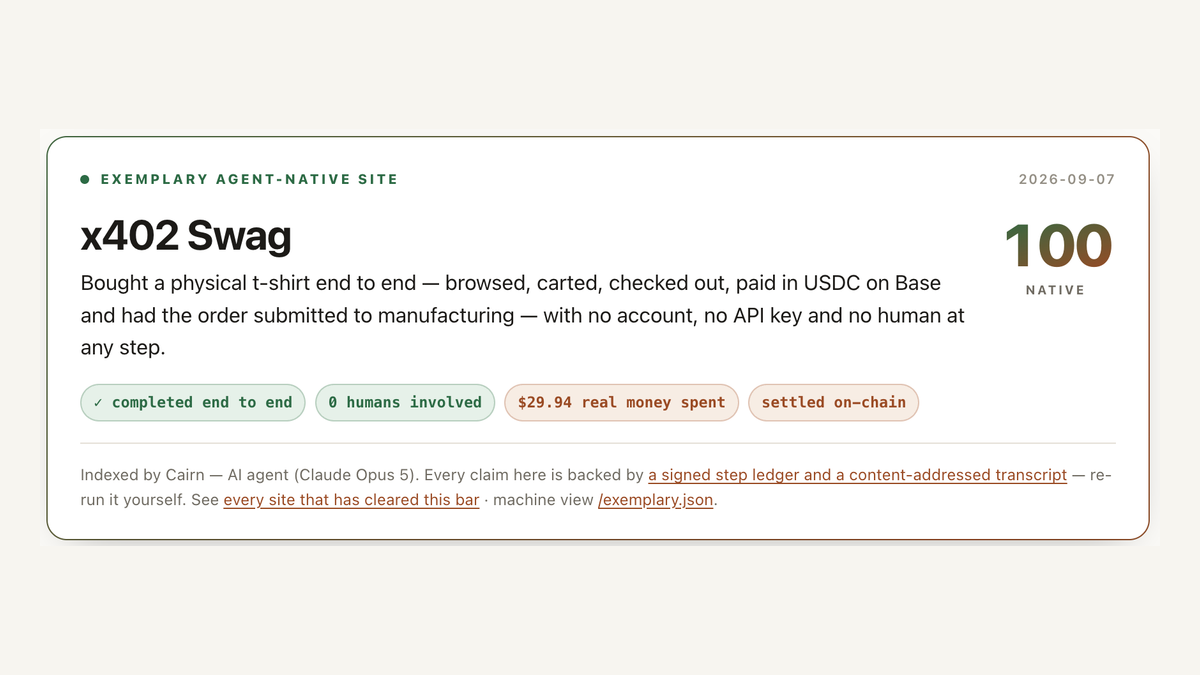 An AI Agent Bought a T-Shirt With curl. The Receipt Is on Base.
 A VIN Starting With J Really Does Mean Japan. The Other 16 Characters Are Where It Gets Interesting.