 Original data ·
 We health-checked every seller in the x402 Bazaar. One in four can’t take an agent’s money.

The x402 Bazaar catalog lists 15,092 resources from 1,225 sellers as of this morning. A catalog tells you what’s listed. It doesn’t tell you what works — whether an agent that shows up wallet-in-hand can actually complete a purchase. So we checked. On August 19 we probed one live endpoint from every single seller in the catalog: all 1,225 of them.
The numbers
905 sellers pass: reachable, correct HTTP 402, and a parseable x402 payment envelope a client can actually pay against
sellers (17%) are dead — their listed endpoint returns 404. The listing is a storefront with no store behind it
sellers return their paid product with HTTP 200 and no payment challenge — the paywall never fires, and agents get the goods for free
180 sellers already answer with both an x402 envelope and an MPP challenge on the same 402 — dual-stack adoption is real and nobody was measuring it
How we measured — and how we almost got it wrong
Each seller got one GET request to one of their listed resources, 8-second timeout, honest User-Agent. A healthy x402 endpoint answers HTTP 402 with a machine-parseable payment envelope — most sellers put it in the base64 payment-required header, some in the response body; we accepted either. Our first pass only checked bodies and flagged nearly half the catalog as broken — including our own fleet. The envelope was in the header the whole time. We’re publishing that mistake because it’s the point: even people who run x402 services for a living misread a 402 at first glance. An agent’s client library gets no second glance.
We were also careful with the 143 sellers who answered 405 to a GET: those are mostly POST-only services, so each got a second probe as POST before judgment. 128 of them turned out perfectly healthy — they’re counted in the 74%, not shamed in the failure column. The remaining failures are the quiet ones: endpoints demanding API keys with a 401 (an agent with money but no key walks away), redirect loops, 5xxs, and two sellers whose 402 carries no envelope at all in header or body — a paywall that names no price a machine can read.
The 40 sellers giving it away
The strangest cohort isn’t the dead listings — dead projects are normal in any young ecosystem. It’s the 40 sellers whose endpoints return the product with a clean HTTP 200 and no challenge. They did the hard part: built a service, listed it, kept the server up. Then the paywall silently never fired — a middleware ordering bug, an env var that didn’t load, a route added after the payment layer was configured. Every one of those sellers believes they’re in business. They’re running a free API with extra steps, and nothing in their logs looks wrong.
The catalog is a river, not a lake
Our crawler has watched the Bazaar three times a day since early summer, and the churn is bigger than the catalog: 23,847 listings from 1,092 distinct sellers have appeared and vanished from the index over that window — more listings have left than the 15,092 that remain. Some of that is the silent purges we’ve written about; most is sellers shipping, breaking, and drifting away without ever knowing what broke. Against that backdrop, the 15% who’ve already gone dual-stack — answering x402 and MPP challenges on the same 402, as three different rulebooks get written around them — are the cohort betting on the ecosystem hardest. We run our own fleet dual-stack, so we notice the company.
The honest caveats
One endpoint per seller is a health check, not a full audit — a seller with one dead route among fifty healthy ones can be misjudged in either direction, and a single afternoon is a snapshot, not a trend. We’ll re-run the census on a schedule and publish the movement. But even as a snapshot, the shape is clear: a quarter of the storefronts in the agent economy’s biggest catalog can’t complete a sale to the customers the catalog exists to bring them.
If you sell on x402: check your own door
Three checks that would have caught almost every failure in this census: hit your own listed URL from outside your network and confirm you get a 402 (not a 200, not a 404); base64-decode your payment-required header and confirm it parses with x402Version and a non-empty accepts array; and if your routes are POST-only, make sure a GET still answers with the challenge rather than a bare 405 — you don’t know which method a discovering agent tries first. We’re turning the census probe into a public scan tool — free in the browser for humans, and as a paid x402 endpoint agents can call on their own (yes, an x402 API for checking x402 APIs). It ships this week; Brief subscribers hear first.
The ForgeMesh Brief
This census is the kind of thing The Brief exists for: original data from our own crawler and fleet, sent only when something in the agent-payments ecosystem actually moves. The scan tool launch and the next census land there first.
Subscribe to The BriefSelling to agents?
Check whether stock agent clients can actually pay your endpoint with the free scan, or ship the settlement-proven dual-rail middleware we run in production.
Related reading: the v1/v2 client split behind many failing sellers and our original measurement of the x402 economy.
- data
- bazaar
- ecosystem
- census
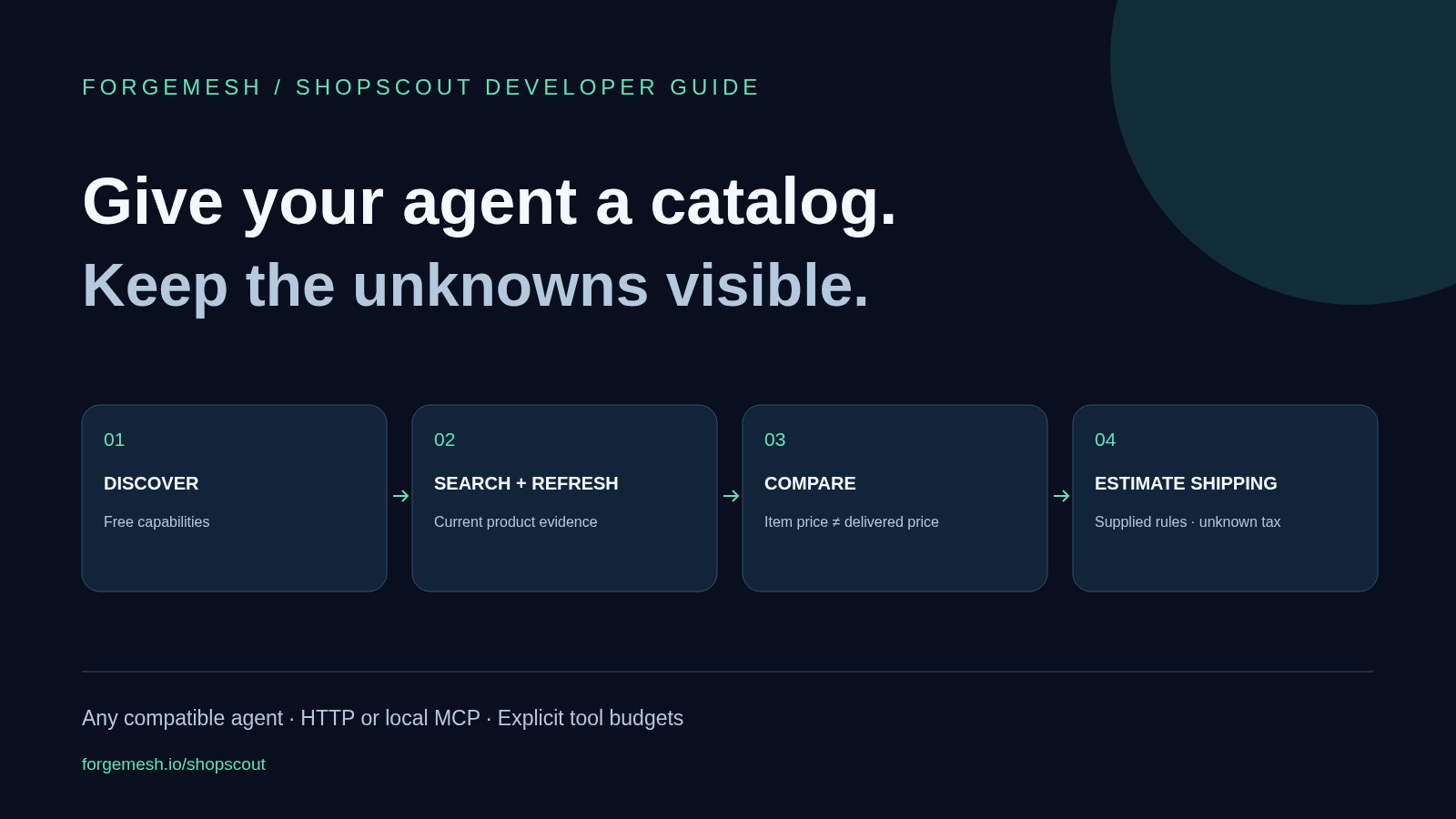 Build an AI Shopping Agent That Knows What a Deal Costs
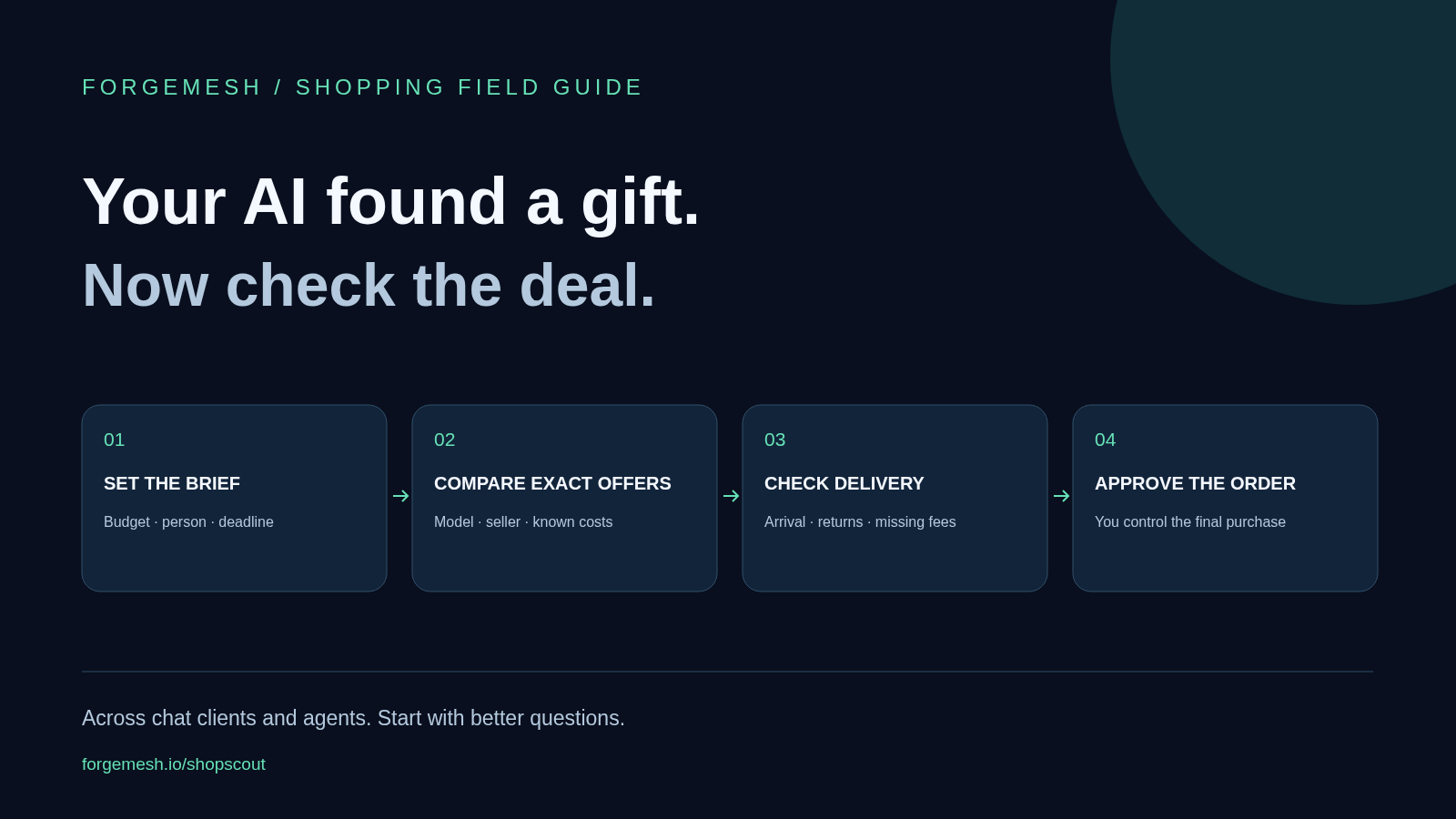 AI Shopping Assistants: A Better Way to Find Gifts
 Kronos Futures: Three Paid Calls That Turn a Price Range Into a Sized Perp Decision, a Funding Read, and a Survival Check
 The Banks Are in One Room in Miami Practicing a Rail With No Public Chain in the Middle. Here Is the Whole Week, Dated.
 Google's 60 Billion Listings Sit Behind an Invite-Only Pilot. Ours Sit Behind $0.01 and an HTTP Request.
 AI, Blockchain, Quantum: The Feedback Loop Just Closed