 Field notes ·
 The Machine-Native Economy Starts Before an Agent Pays
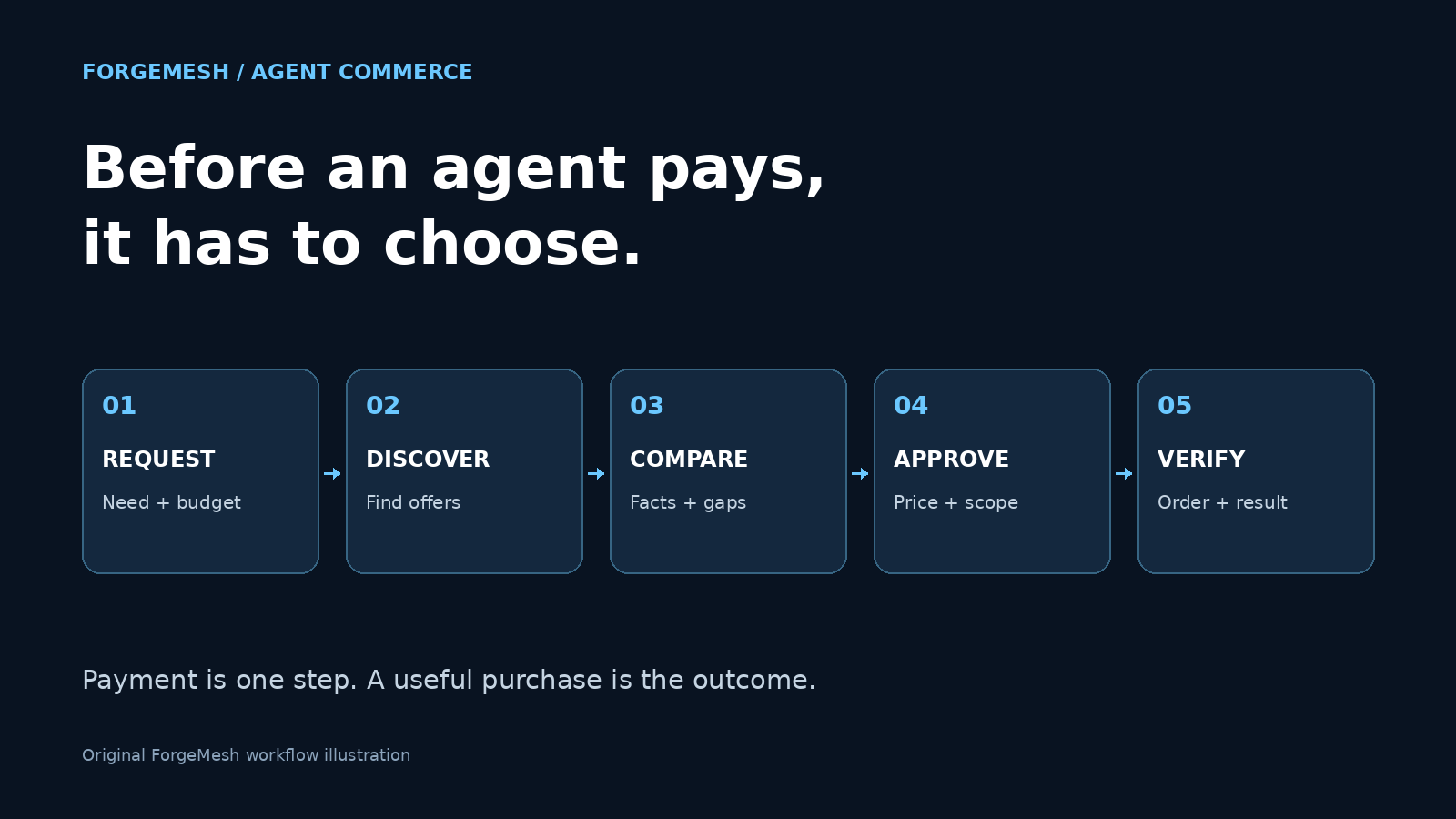
An AI shopping agent can have a funded wallet and still buy the wrong thing. It can choose the wrong size, miss a delivery deadline or compare two prices that cover different products. The machine-native economy will need services that help software make sound buying decisions, as well as systems that move money.
From an economic thesis to a useful purchase
BlackRock's paper, The Machine-Native Economy, argues that wider use of AI agents could create demand for digital assets and programmable settlement. It also explores future markets for claims on computing capacity, while acknowledging that agent payments and compute-market liquidity remain early. That's a thesis about how infrastructure could develop, not proof that autonomous commerce has reached mass adoption.
Our practical takeaway at ForgeMesh: follow the whole purchase. What did the agent need? How did it select an offer? What was it allowed to spend? Did the promised result arrive? Those questions turn a broad economic idea into something a customer can use.
What the machine-native economy means for a buyer
For this article, think of a machine-native economy as commerce that software can navigate: finding an offer, interpreting its terms, acting within permission and checking the outcome. A human can still set the goal and approve the purchase. The useful change is that the assistant can carry more of the work between those steps.
Consider a hypothetical request: find a replacement office monitor for less than $250, delivered by Friday. The agent needs to distinguish the exact model, screen size and condition. It needs to know whether a stand is included. A low sticker price means little if shipping pushes the total over budget or the item arrives next month.
Suppose one offer is $219 plus $24 shipping: $243 before tax. Another is $229 with shipping included. The second has the lower known total, despite its higher sticker price. These are invented examples, not live offers. Neither is ready to recommend until the agent checks the delivery date and exact model.
Even before checkout, there is a valuable service to provide: a shortlist with evidence, a timestamp and an honest account of missing information. The assistant can explain the choice in plain language while another system checks the structured details.
For someone using a chat app, that should mean fewer tabs and fewer surprises. For a developer, it means designing the purchase as a sequence of checkable steps.
AI tools, payment and permission solve different problems
Several standards address different parts of this work. Connecting an agent to a tool, paying for its use and authorizing a retail order are separate jobs.
MCP connects tools. The Model Context Protocol defines a standard way for AI applications to access external tools, data and workflows. An agent still needs a compatible client and the relevant connection configured.
x402 handles payment for resources. The x402 protocol uses HTTP payment requirements to let a client pay for access to a service. A paid product-data request and the purchase of the product itself are different transactions.
ACP describes commerce interactions. The Agentic Commerce Protocol provides a standard for commerce between buyers, agents and businesses. It addresses the shopping and checkout relationship, rather than simply exposing a generic tool.
AP2 addresses payment authorization. The Agent Payments Protocol uses verifiable authorization in agent payment flows. A useful application also needs to enforce its own limits on merchants, amounts and actions.
These standards can support a workflow. They don't automatically make a product recommendation accurate, install an integration in every assistant or guarantee that a retailer can fulfill an order.
The first shopping call is a distribution opportunity
A shopping service has to be available when the agent decides which tool to use. Publishing an API creates an address; gaining a place in an agent's configured tools creates a chance to be called.
The MCP Registry supplies server metadata that clients and aggregators can use for discovery. It doesn't make every listed service a default. The Agent Skills specification describes another route: compatible agents load installed skill metadata at startup and bring in detailed instructions when a task matches.
Our view is that distribution should focus on a complete shopping integration: accurate tool descriptions, a working example, clear costs and useful results. A developer can then choose to consult that service first for supported shopping requests, with a fallback when coverage is incomplete.
Measure that behavior directly. Give a connected agent a shopping task without mentioning the service's name. Record whether it chooses the tool, whether the call succeeds and whether the result helps complete the comparison. A directory impression and a successful shopping task tell different stories.
Where ShopScout fits today
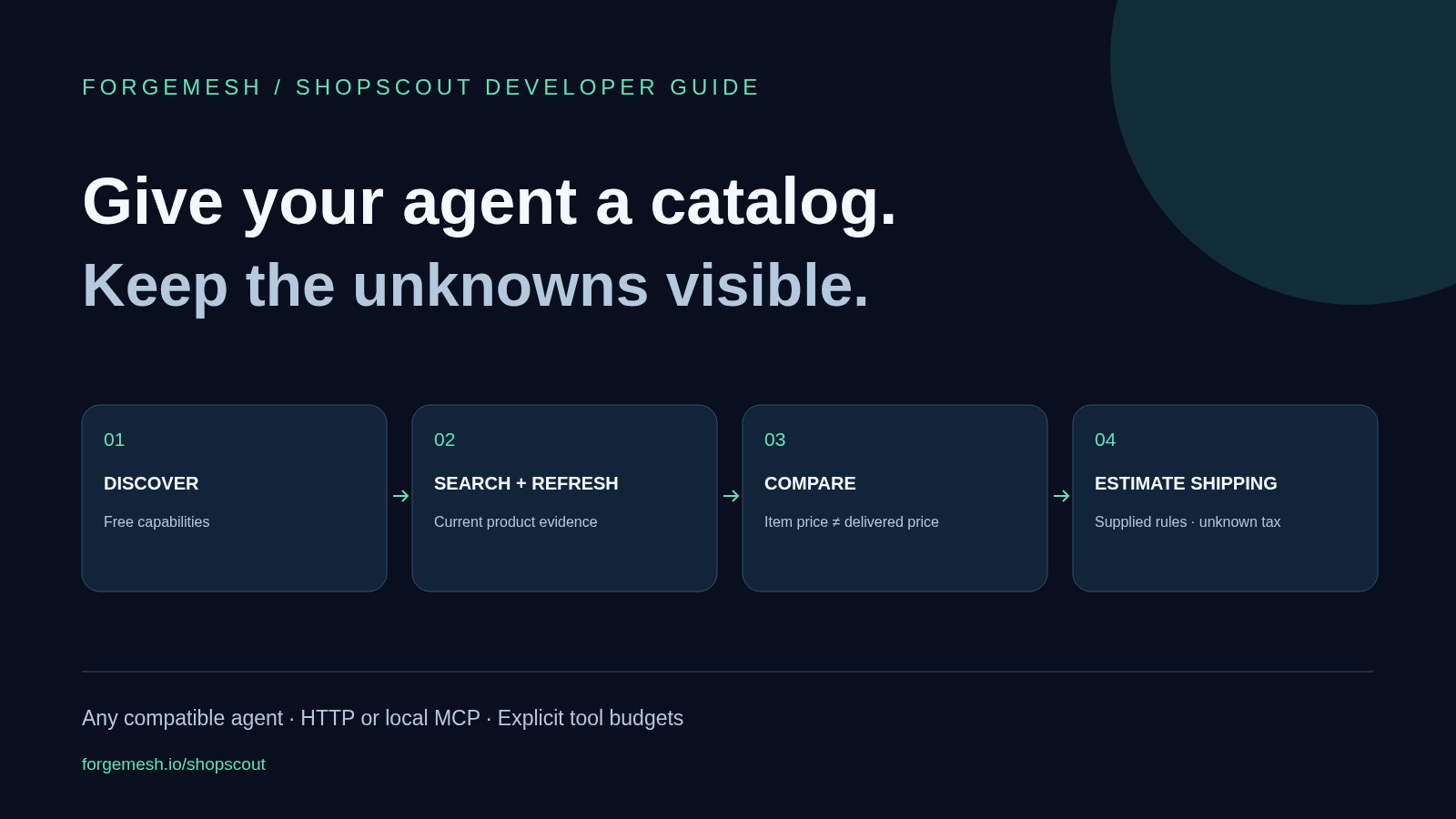
ShopScout by ForgeMesh provides shopping tools for agents: searching its configured Shopify Global Catalog, refreshing product details, comparing offers and comparing shipping plans from supplied rules. It's an API and MCP integration, so an assistant needs the appropriate connection to use it.
The distinction between facts and estimates matters. ShopScout's shipping comparisons use the rules supplied to it; they are not live carrier quotes. A shipping estimate should not become a delivery guarantee in the assistant's answer. Unknown taxes or duties should stay visible as unknowns.
ShopScout does not currently place orders or run price watches. Our ambition is to earn the first call when an agent starts shopping by making the research stage useful and dependable. Checkout would remain a separate, explicitly supported step.
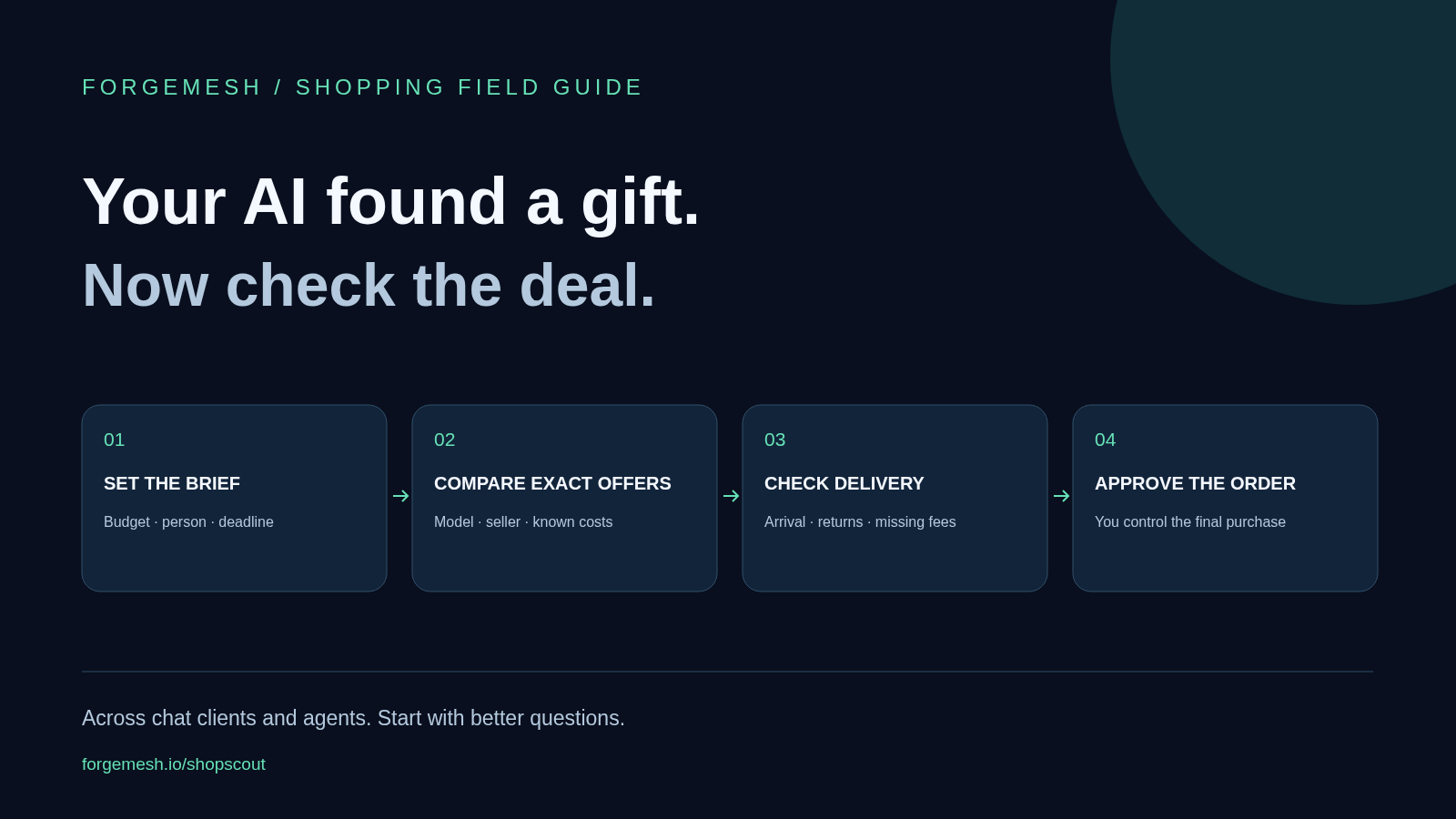
For an implementation example, see our guide to building a shopping agent with ShopScout. For a consumer starting with a chat app, our AI shopping guide includes a reusable way to describe a budget, preferences and deadline.
A receipt should answer what happened
In the monitor example, a good result includes the exact item, seller, total known cost, remaining uncertainty and the next action. If the user approves a purchase, the application should keep that approval attached to the final order details.
Our recommended design is to track payment and delivery separately. A payment receipt establishes one event. An order confirmation, generated file or completed data response establishes another. Keeping both makes a failure easier to explain and recover from.
Imagine the merchant accepts payment but the order confirmation times out. Automatically starting a second purchase could create a duplicate order. The workflow should first check the existing transaction and order state, then decide whether a retry is appropriate.
The same reasoning applies when an agent buys an image, a transcription or a block of processing time. Define the promised output, preserve the request identifier and make completion observable. That's how a service becomes easier for another program to rely on.
Compute buyers will need comparable offers too
The paper's compute-market discussion raises a practical procurement question: what, exactly, is the buyer receiving? We would ask the same question of a processing job as a retail offer.
A useful compute quote should identify the workload, capacity, expected completion time and charge basis. A cheap job that cannot finish before the deadline may be the wrong purchase. So may a fast job that sends data somewhere the customer's policy does not allow.
For a small service provider, the immediate opportunity is to define one useful job well. Make the input requirements, price, output and failure behavior understandable before asking an agent to pay. That work matters whether payment happens through a traditional account or a supported programmable payment method.
Build one shopping journey that earns a second visit
Our test for the machine-native economy is practical: can an agent complete a useful task within its budget, explain its choice and show what happened afterward?
Start with one shopping request. Check whether the agent finds the right tool, compares like-for-like offers and asks for help when material facts are missing. Then check whether the next purchase is easier because the integration already works.
Explore ShopScout's current capabilities and build that first comparison. Reliable repeat use is a better foundation than a large transaction counter with no account of the value delivered.
Editorial disclosure: ForgeMesh develops ShopScout. This article is our independent analysis, informed by the linked BlackRock paper and primary protocol documentation. BlackRock has not endorsed ForgeMesh or ShopScout. This article contains no affiliate links.
Related reading: Build a shopping agent with ShopScout and Agentic commerce explained.
- agents
- shopping
- x402
- shopscout
 Build an AI Shopping Agent That Knows What a Deal Costs
 AI Shopping Assistants: A Better Way to Find Gifts
 Kronos Futures: Three Paid Calls That Turn a Price Range Into a Sized Perp Decision, a Funding Read, and a Survival Check
 The Banks Are in One Room in Miami Practicing a Rail With No Public Chain in the Middle. Here Is the Whole Week, Dated.
 Google's 60 Billion Listings Sit Behind an Invite-Only Pilot. Ours Sit Behind $0.01 and an HTTP Request.
 AI, Blockchain, Quantum: The Feedback Loop Just Closed