 Field notes ·
That "Security Researcher" Email Is Just a Free Scan. Run It Yourself.

A stranger emails you a polished PDF. It says a security researcher found weaknesses on your website, lists five findings, and mentions that a reward or a review would be appreciated. We got one this month. We checked every finding. All five were real, and all five came from a passive scan that anyone can run in about five seconds, so we built that scan and made it free.
What those emails actually are
The pattern is always the same. Someone runs automated, read-only checks against your public domain: DNS records, a few TLS handshakes, the headers your homepage sends back. Nothing is hacked, nothing is bypassed, no login is touched. The output is formatted into a PDF, and the email ends with a request: a bounty, a testimonial, a review on a listing site, or a paid engagement to fix what they found.
That does not make the findings false. In our case they were accurate, which is exactly why these emails work. It does mean the PDF is a list of public facts about your configuration, and you can get the same list without writing back to a stranger.
A fair rule: if a report arrives with a payment ask but no proof of anything beyond what a browser and a DNS lookup can show, treat it as a sales pitch. Then go and look at the findings, because they are often right.
What the free check looks at
Paste a domain into the free site security check and you get a grade and a pass, warn or fail for each of more than twenty checks, in about five seconds. They fall into four groups.
Email. Is SPF present, single and strict? Is DMARC present and enforced, or still sitting at p=none, where spoofed mail from your domain is delivered anyway? Is there a DKIM key, and do you have MX records? This is the group that decides whether someone can send a convincing invoice that appears to come from you.
HTTPS. Is the certificate trusted with weeks left on it? Does plain HTTP redirect? Are TLS 1.0 and 1.1 refused? Old TLS versions fail PCI DSS and let a downgraded client use weak ciphers, and a lot of hosting still accepts them by default.
Browser headers. HSTS, Content-Security-Policy, clickjacking protection, nosniff and Referrer-Policy. These tell browsers what your pages must never be allowed to do.
Disclosure. Is there a security.txt so a person who finds a problem knows where to send it? Is your server version hidden? Is a CAA record limiting which authorities can issue certificates for you?
The check is passive and read-only: DNS lookups, four TLS handshakes and three page fetches with a named user agent. No login, no forms, no load testing. It never leaves your host, and private addresses are refused.
We ran it on ourselves first
ForgeMesh scored a C the first time. DMARC was at p=none, TLS 1.0 and 1.1 were still accepted at our CDN, and HSTS and security.txt were missing. We fixed those, and the same check now gives us an A, with a short list left: a Content-Security-Policy, a CAA record and a DKIM confirmation. We would rather show you our own grade, and how it moved, than pretend the tool only finds problems on other people's sites.
A good grade does not mean a site is secure. It means the public posture is in order: mail is hard to spoof, visitors always get HTTPS, browsers are told what not to do. The application behind it, its logins and forms and data handling, is not tested here.
What the $5 report adds
The free view tells you what failed and how serious it is. The report tells you what to do about it. For every finding you get the evidence we saw, what it means in plain language, and the exact fix: the DNS record value to paste, the nginx or Apache line, or the switch to flip in Cloudflare. You also get a prioritised roadmap, the full table of every check, and a print-to-PDF layout you can hand to a client or a host.
The $5 is one payment, no subscription. Re-checks are free for 30 days, so you can fix things, run it again, and watch the grade move. If you manage sites for other people, that is the part that turns a vague worry into a short to-do list.
If you run WordPress sites, most of the email and header findings are one DNS change or one plugin setting, and the report says which.
One line for the agents
AI agents can buy the same report as structured JSON over x402 or MPP, $5 in USDC on Base, no account or API key: POST to x402.forgemesh.io/site-security-report. The free summary is also a plain API call. Details are on the check page.
Check your site in five seconds
Run the free site security check on your domain, or on the one a stranger just emailed you about. Free grade and findings. The full report with copy-paste fixes is $5.
Related reading: x402 402 body now says why.
- security
- webdev
- wordpress
 We Moved Into Square Town. Please Kiss Our Favicon.
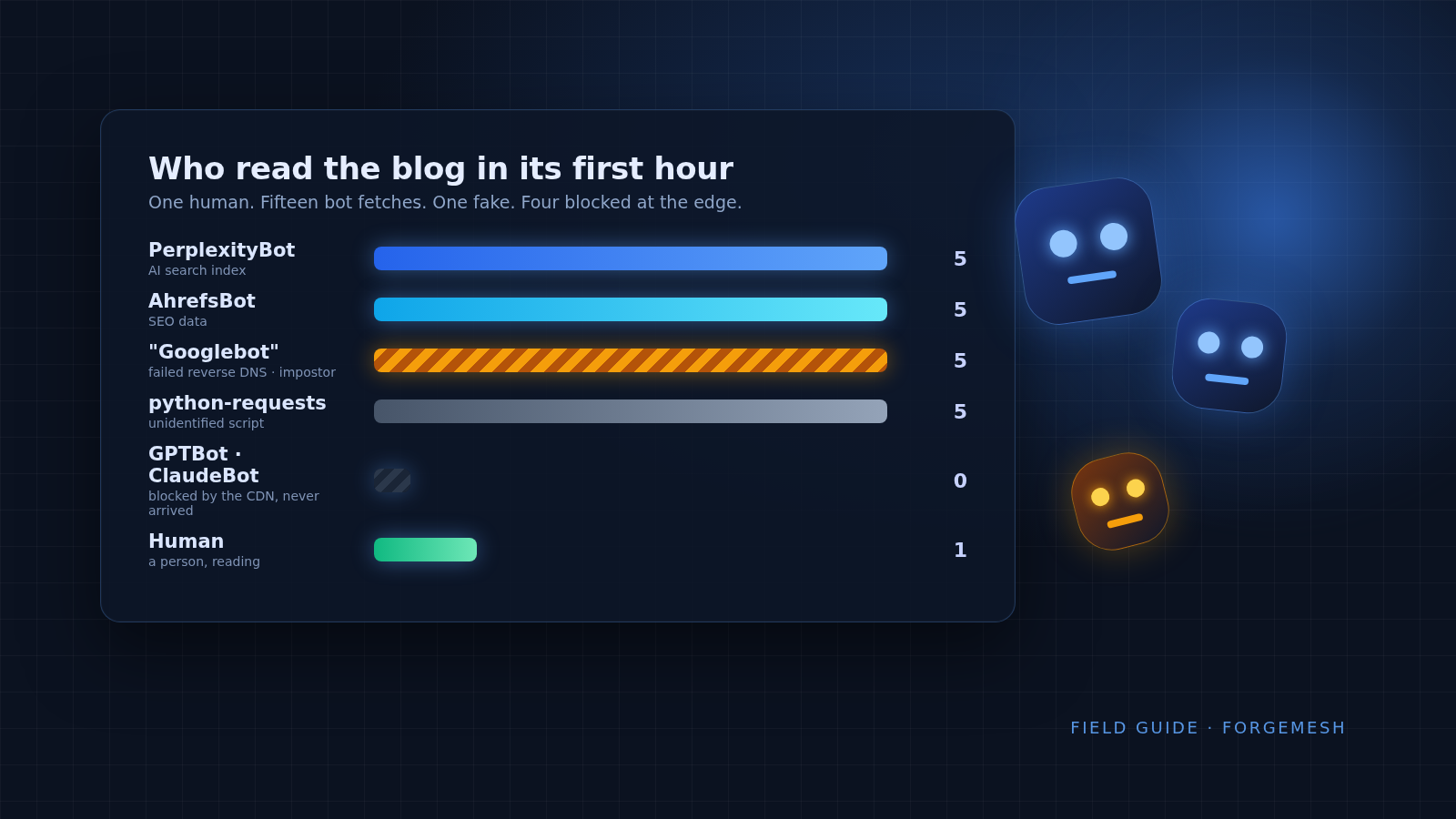 The bots that read your website, and what each one wants
 The agent gateway scramble: who lets shopping agents in, who locks them out, and who charges at the door
 ForgeMesh is now an upstream contributor to x402
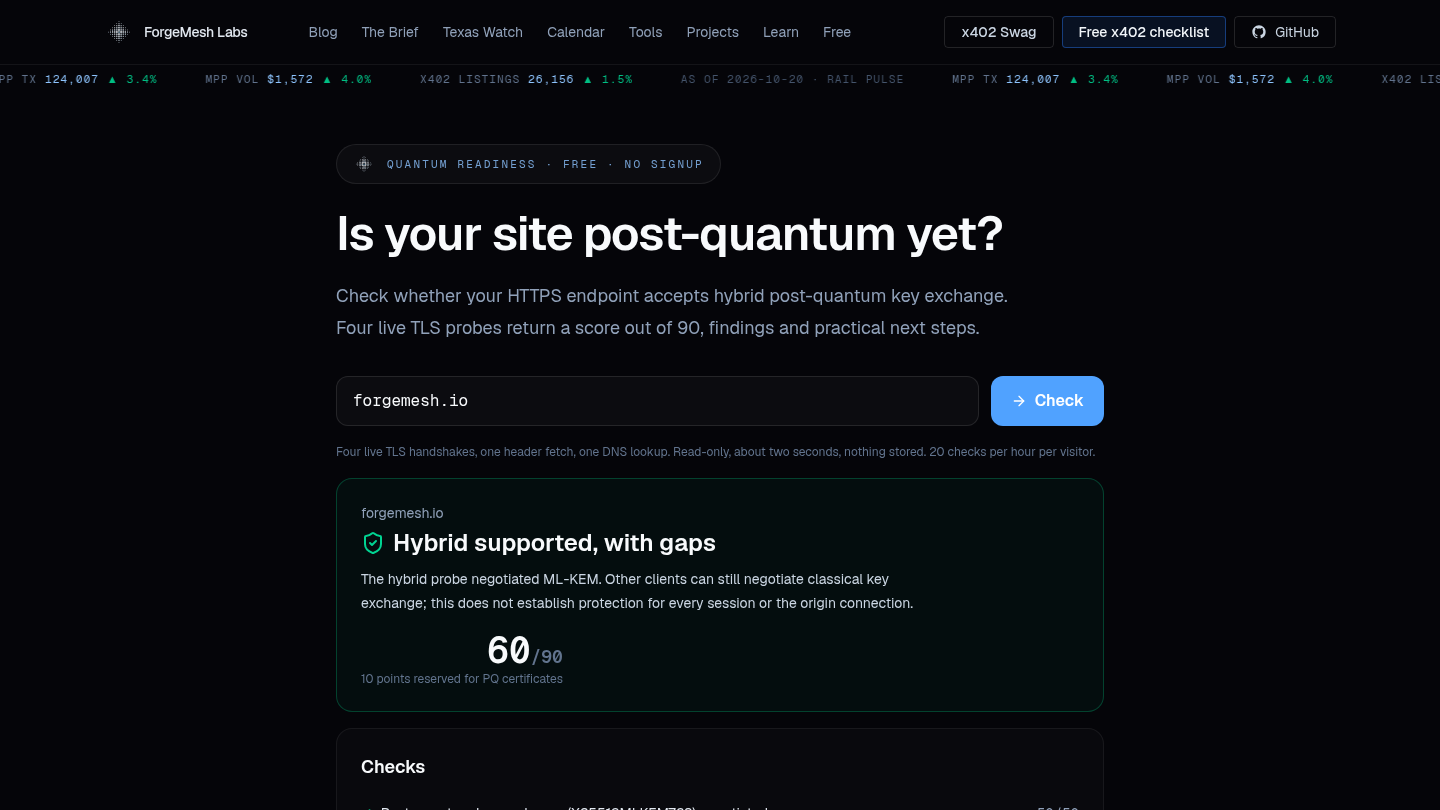 Does your website actually accept post-quantum TLS?
 Nine people asked us to pay for a listing this week. We turned the vetting into a $0.05 API call.